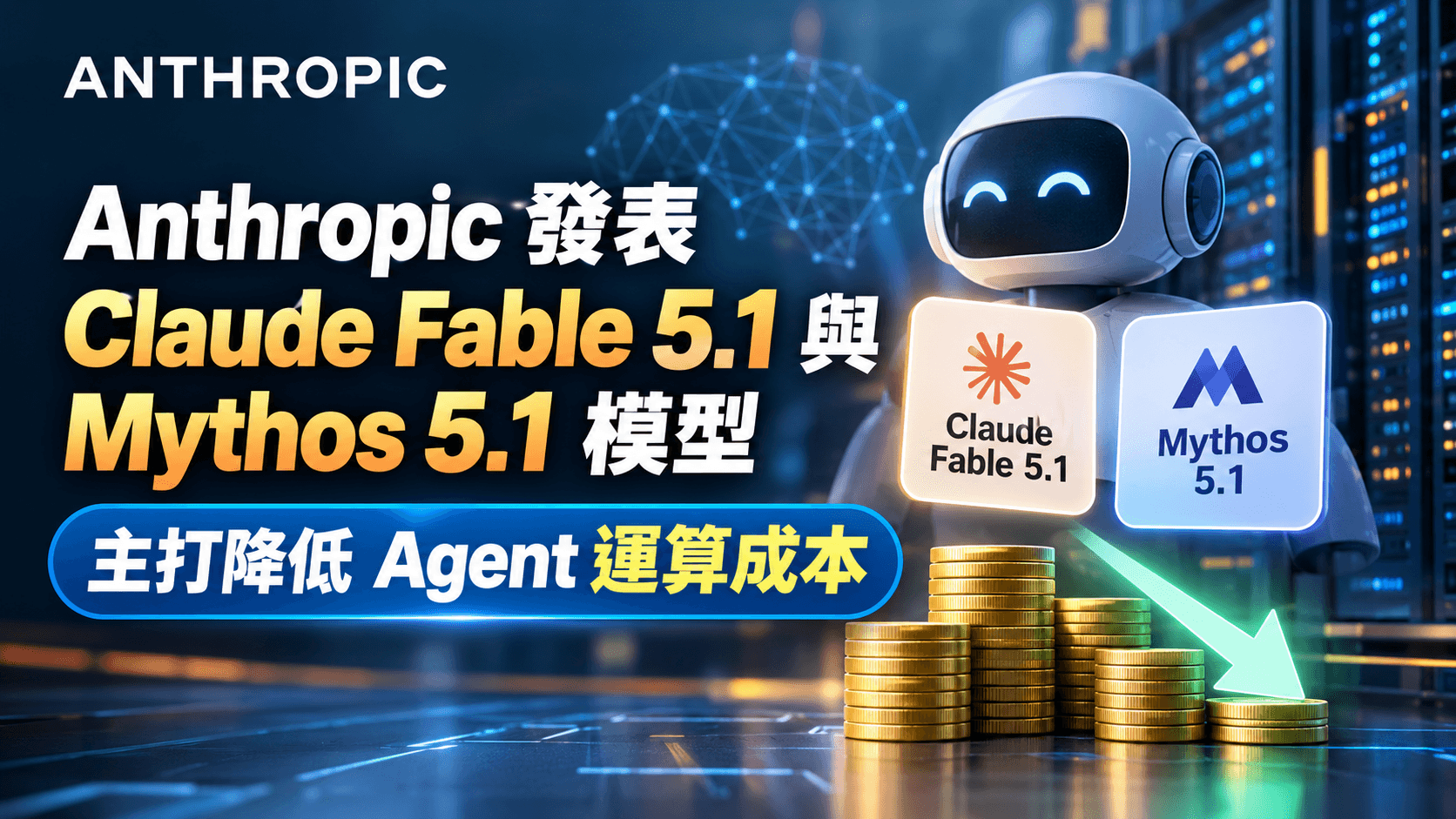
Anthropic today officially unveiled its new-generation flagship large language model Claude Fable 5.1 and the defense-focused Claude Mythos 5.1, bringing a milestone compute upgrade to software engineers and digital knowledge workers around the world. As generative AI reaches the critical turning point from simple chat to autonomous AI agents, the market's biggest pain point is no longer a lack of model intelligence but the staggering inference costs that pile up from continuous calls and high-frequency iteration. This update not only makes key breakthroughs in code generation and complex reasoning but also focuses its core competitiveness on what enterprises care about most: "price-performance" and "real-world feasibility."
The core of this upgrade targets the barrier to large-scale commercial use of AI agents. In the past, companies deploying fully automated workflows often faced steep cloud bills from long-context memory retrieval and repeated verification, which kept many proof-of-concept (PoC) projects from reaching production. Through improvements to its underlying architecture and an innovative caching price model, Claude Fable 5.1 precisely removes this financial bottleneck, telling the market that advanced intelligence is no longer an expensive luxury for a few giants but standard cloud infrastructure every efficiency-minded business can afford.
Key takeaways
- Significantly lower compute costs: Claude Fable 5.1 cuts average compute costs by 25%, with savings of up to 45% on complex agent workloads.
- More precise safety mechanisms: far fewer wrongful blocks on basic science, and support for software vulnerability identification and analysis for the first time.
- Tiered deployment strategy: Fable 5.1 is fully available starting today, while the top-tier Mythos 5.1 is reserved for Project Glasswing security partners.
Architecture optimization and cache pricing: the technology behind a 45% drop in agent compute costs
The key to Claude Fable 5.1 achieving an average 25% cost reduction while improving inference quality is lightweight tuning of the model architecture and a fundamental breakthrough in memory access efficiency. In ordinary single-question scenarios, the algorithm skips unnecessary attention-weight computation, greatly lowering the marginal energy cost of each token. This is reflected in the API pricing, giving developers a very competitive unit cost for inference.
For complex AI agent workloads, Prompt Caching optimization is what pushes the cost reduction up to 45%. When automated agents run multi-step, multi-turn debugging or analyze huge codebases, the system no longer bills repeatedly for the large conversation history; instead, it reuses already-processed semantic indexes through an efficient server cache architecture. This breakthrough design cuts off the snowballing costs of long multi-turn conversations and completely overturns the cost structure of building modern software development toolchains.
A practical shift in safety alignment: unlocking vulnerability analysis and scientific exploration
Anthropic has significantly fixed the much-criticized problem of over-cautious refusals (refusal rate), letting the model offer more practical value while still respecting ethical limits. Earlier versions' overly sensitive safety filters often misjudged normal scientific exploration in areas such as quantum mechanics and biochemistry as potential threats, creating many obstacles for academic research and corporate R&D. The new Fable 5.1 uses more fine-grained contextual intent recognition to sharply reduce these pointless defensive responses, giving researchers a smooth experience again.
Even more notably, Claude Fable 5.1 officially supports software vulnerability identification and security analysis for the first time, marking a major evolution in AI security strategy. In the past, most model providers strictly restricted code vulnerability detection, but the new version gives compliant developers the powerful ability to proactively scan for system flaws and guard against potential cyberattacks. This shows not only that the technical team is more confident in the model's situational safety judgment, but also gives white-hat hackers and automated DevSecOps pipelines an unprecedented arsenal.
A two-track product strategy and its market impact: top-tier Mythos 5.1 builds a high-end defensive moat
Anthropic's two-track release strategy clearly separates the mass commercial market from the defense needs of national-level critical infrastructure. Claude Fable 5.1, aimed at businesses and individuals at large, is fully live on open platforms to quickly grow its developer ecosystem and compete with existing rivals for share of cloud inference. The even more powerful top-tier flagship Claude Mythos 5.1 remains under very strict access control, reserved for specific security defense partners in Project Glasswing.
This strictly limited, privileged access highlights the strategic sensitivity of top AI as a dual-use technology for both defense and offense. As top models approach the abilities of elite human security experts in code penetration, reverse engineering and vulnerability discovery, releasing them without restraint could create systemic risks across global cyberspace. By integrating deeply with trusted defense and security partners, Anthropic can validate peak performance while preventing cutting-edge technology from being abused by malicious actors, setting an industry standard for responsible scaling.
Practical lessons for Taiwan's tech industry: accelerating enterprise AI transformation
Taiwan's thriving software development teams and multinational manufacturing supply chain will be the biggest beneficiaries of this round of cost cuts and feature upgrades. Many local companies adopting AI customer service, automated report analysis or ERP integrations in the past struggled to scale because token costs were too high. With Claude Fable 5.1 bringing up to 45% savings on long-context costs, Taiwanese CIOs and technical leaders can rebuild internal software engineering processes and knowledge management systems on a more affordable budget.
In addition, as a core global hub for semiconductors and high-tech manufacturing, Taiwan has always depended on security resilience to keep its supply chain running smoothly. Fable 5.1, with its new support for software vulnerability identification and analysis, can be embedded directly in Taiwan's software development life cycle (SDLC), helping companies automate source code review and threat modeling at very low cost before shipping. This will greatly strengthen the local tech industry's ability to resist advanced persistent threats (APTs) and cement Taiwan's key strategic position as a trusted global supply chain in the age of AI.
Frequently asked questions (FAQ)
In what ways does Claude Fable 5.1 lower companies' operating costs?
Claude Fable 5.1 lowers costs through both a lighter model architecture and advanced caching. Base inference costs fall by about 25% overall, and in complex AI agent workflows that need multi-turn interaction and long-context calls, Prompt Caching optimization can cut total compute costs by up to 45%, greatly easing the financial burden of long-running automated tasks.
Why isn't Mythos 5.1 open to all users in the public market?
Mythos 5.1 is strictly controlled because of its extremely powerful software reverse-engineering and security analysis abilities. To prevent the top model's advanced reasoning from being misused for cyberattacks or weaponizing vulnerabilities, Anthropic has adopted a defense-first governance strategy and currently limits access to specific security and national defense partners in Project Glasswing, ensuring the key technology operates safely in a controlled environment.
What concrete benefits does this update bring to software development and security testing?
The new model officially unlocks software vulnerability analysis for the first time and greatly reduces wrongful blocks on scientific queries. Development teams can now use Claude Fable 5.1 directly for automated source code vulnerability scanning, architecture security reviews and debugging, while the previously over-sensitive safety blocks have improved significantly, letting everyday software development and scientific R&D move quickly without interruption.
The release of Claude Fable 5.1 and Mythos 5.1 makes it clear that the focus of generative AI competition has shifted fully from parameter counts to architectural efficiency, precise safety management and real return on investment (ROI) for businesses. When advanced inference costs are no longer prohibitive, intelligent agents will quickly spread into every corner of modern software engineering and business decision-making. For business leaders evaluating their next-generation digital transformation architecture, now is the best time to take stock of internal automated workflows and embrace cost-effective AI infrastructure.