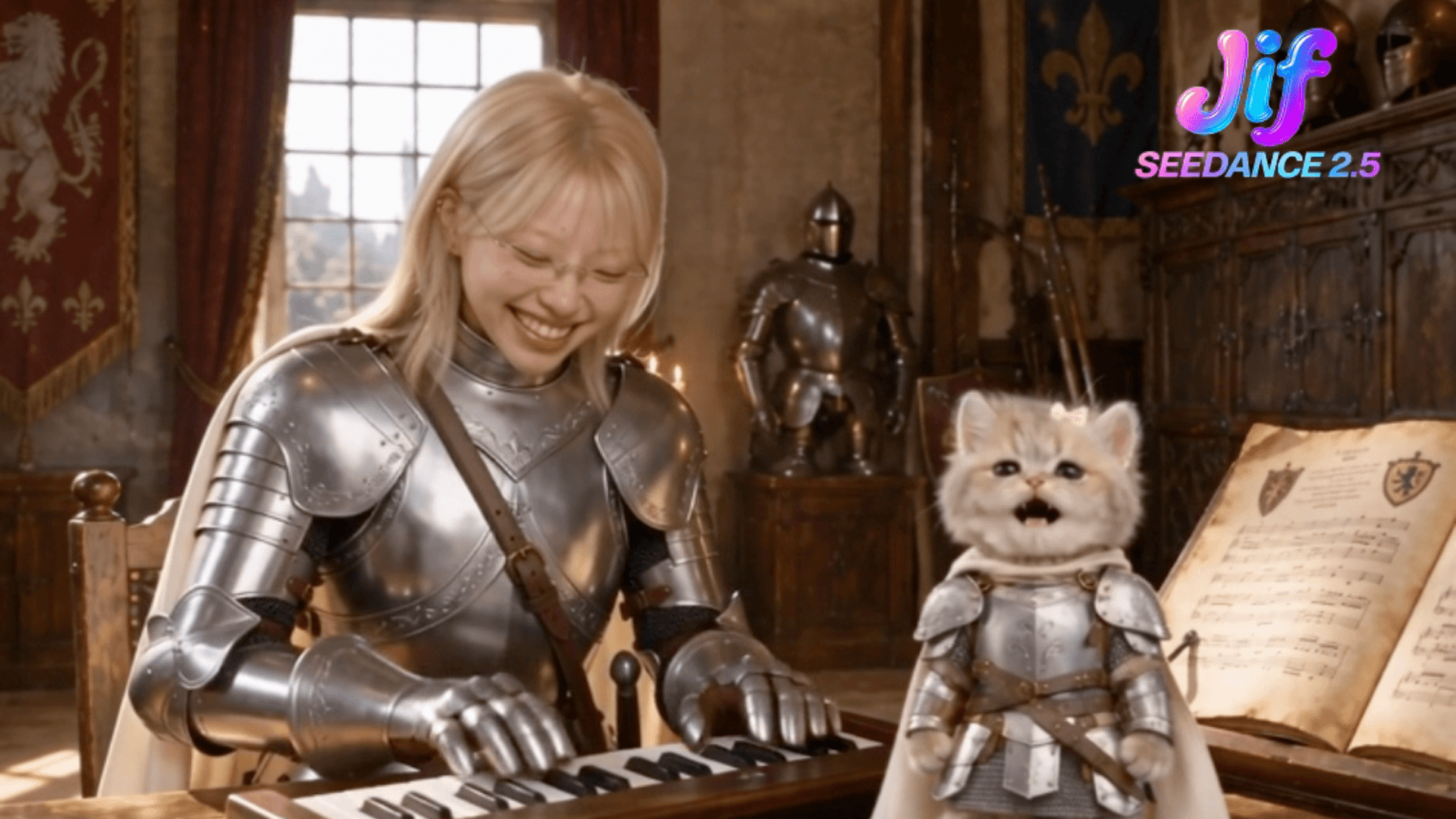
Prepare 1 Video and 4 Reference Images
First, open JifChat Canvas and upload the original video whose camera work you want to recreate. This video will determine the timing, editing, camera positions, character blocking, and pacing of the entire sequence.
Video reference:
Next, prepare four reference images:
Image 1: Final Dance Scene
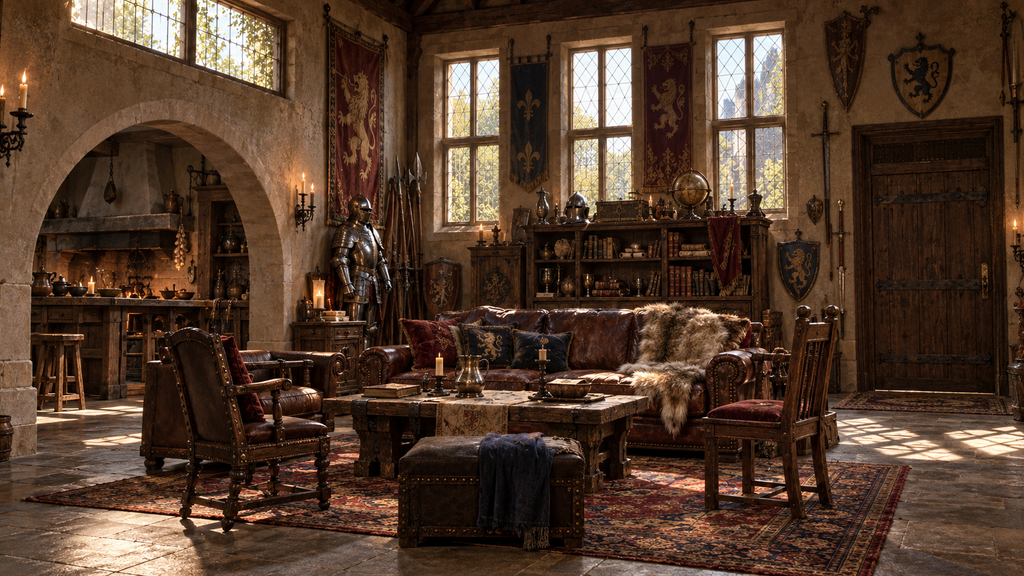
Choose a spacious medieval knight’s chamber. This will be used for the final part of the video, when the characters move toward the camera.
Image 2: Pet Character
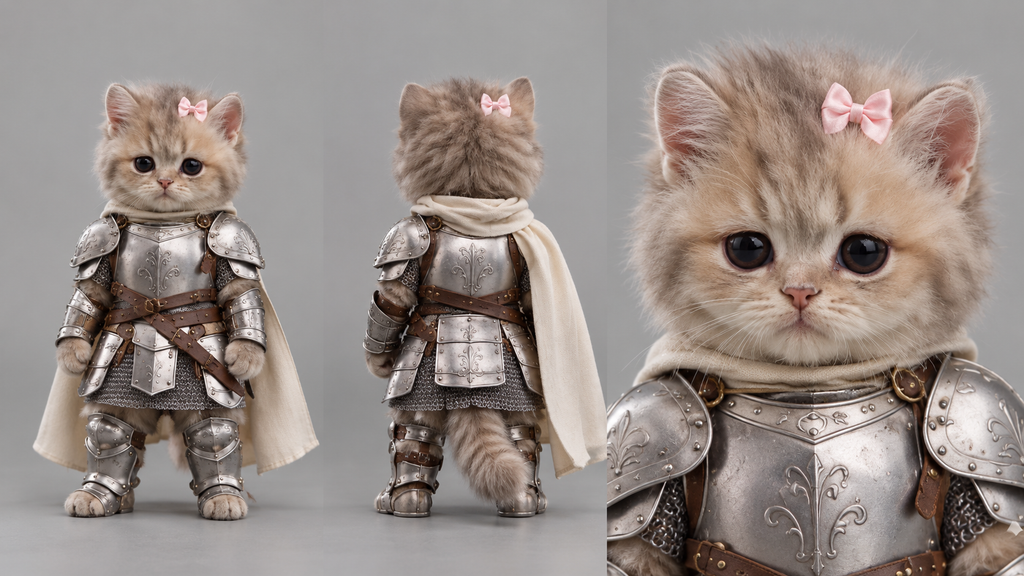
For this example, we’re using a kitten dressed in silver knight’s armor. It’s best to prepare a clear character sheet in advance so the kitten’s fur color, face, armor, and accessories remain consistent.
Image 3: Desk Scene
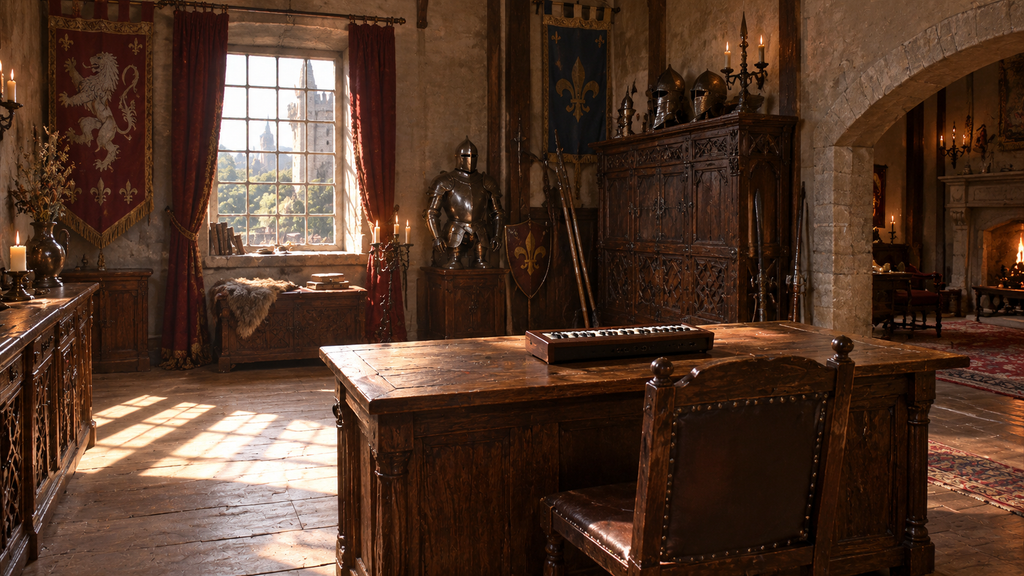
This image will control the first half of the video. Ideally, the scene should already contain a clearly visible wooden desk and enough room for the characters to move.
Image 4: Main Character Sheet
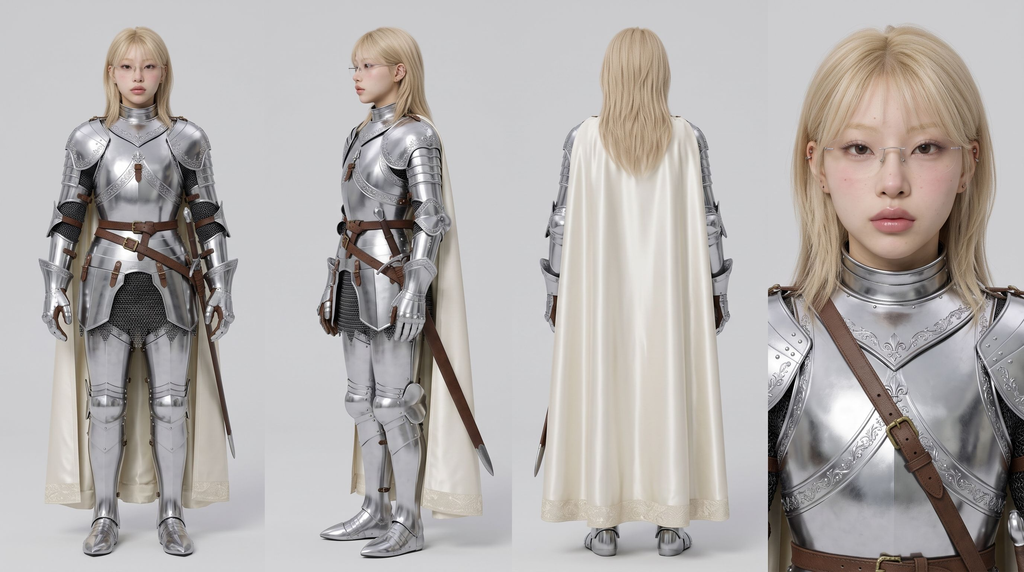
The main character in this example is a female knight. Her character sheet should ideally include front, side, and back views, along with a close-up of her face, so the video model can keep her identity consistent.
Place all four images on the same JifChat Canvas. We’ll connect them directly to the video generator in the next step.
Create a Video-Generation Node in Canvas
In JifChat Canvas, click the “+” button on the left to add a video-generation node. Then add:
{Original video + Image 1 + Image 2 + Image 3 + Image 4}
Select the Seedance 2.5 model and set the video to 30 seconds with a 4:3 aspect ratio.
Connect everything to the video generator.
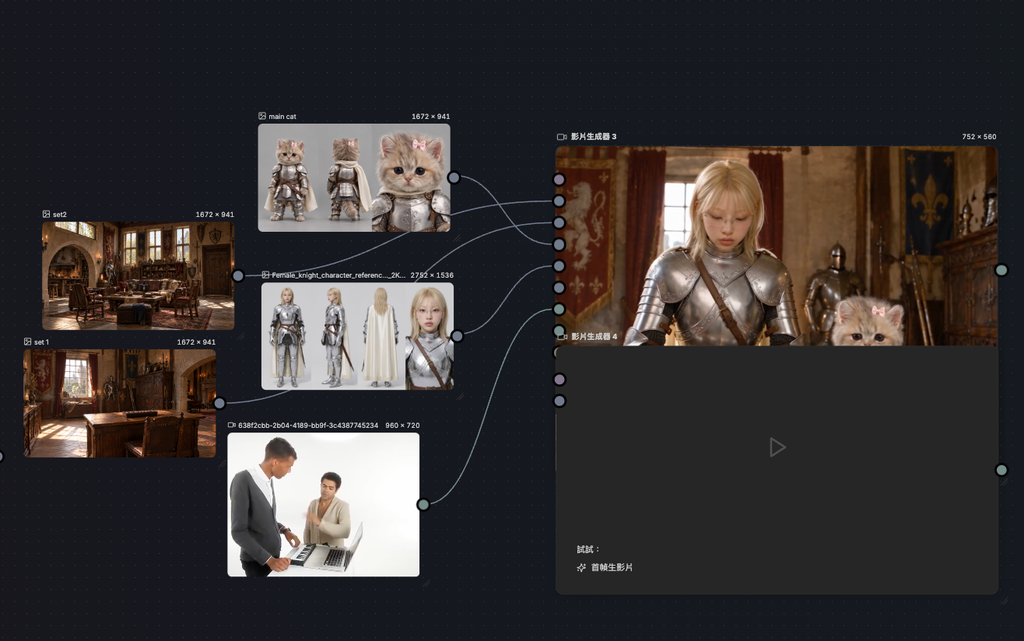
Paste in This Complete Prompt
You can copy the full prompt below directly into the video-generation node in JifChat Canvas:
Replace the characters and setting. Fully replicate the timing, pacing, editing, camera movement, blocking, character positions, and overall energy of <<>>. Change only “who is performing” and “where the action takes place.” Do not redesign the original video’s visual or camera language.
<<>> controls only the identity of the main performer. The protagonist must be the exact same female knight shown in the reference image. Fully preserve her real facial identity, blonde hairstyle, body proportions, silver medieval plate armor, long white cape, brown leather belt, glasses, and every clothing accessory. There must be zero identity drift throughout the video.
<<>> controls only the second performer: the kitten. Fully preserve the exact same real kitten shown in the reference image, including its species, breed, true-to-life size, fluffy cream-and-apricot fur, facial markings, large eyes, pink bow, silver medieval kitten armor, off-white cape/scarf, and leather accessories. It must remain a real four-legged kitten at all times and must never become humanoid.
<<>> controls only the desk scene from 0–24.6 seconds. Preserve 100% of the European medieval knight’s chamber shown in the reference image: stone walls, dark carved wooden furniture, red and dark-blue heraldic banners, displayed suits of armor, weapons, a fireplace, a wooden desk, warm natural sunlight, and a medieval color palette.
<<>> controls only the final dance sequence from 24.7–30 seconds. Preserve 100% of the large medieval knight’s chamber shown in the reference image, including its stone architecture, dark wooden furniture, leather sofa, heraldic banners, armor, rug, natural sunlight, and warm color palette. <<>> and <<>> must look like two different areas within the same medieval knight’s residence—not two completely unrelated locations.
Original video LEAD → <<>> female knight. She inherits the original lead performer’s exact timing, performance rhythm, position, and main actions on a one-to-one basis.
Original video SECOND performer → <<>> kitten. The kitten inherits only the second performer’s position in the frame, timing, and audio/singing rhythm. Completely ignore the original second performer’s human body movements, hand gestures, dance moves, and method of locomotion.
Everything from 0–24.6 seconds takes place in <<>>. Use the large wooden desk from the reference image as the performance table.
There is only ONE small, old-school miniature electronic wooden piano on the desk: a small rectangular electronic keyboard with a vintage wooden casing, small black-and-white keys, and a subtle design that suits the medieval wooden environment.
No laptop, computer, monitor, speakers, other electronic equipment, or additional modern props on the desk. The female knight uses only this miniature wooden electronic piano throughout the sequence.
The female knight follows the original lead performer’s timing exactly. Standing at the wooden desk, she uses the miniature wooden electronic piano to build the beat, nodding and reacting in time with the rhythm. At the original video’s climactic moment, she raises both hands according to the lead performer’s exact timing.
The kitten remains seated on the wooden desk beside the keyboard and stays at the realistic size of a domestic cat. Its body must remain completely still: all four paws stay naturally planted, its body does not change position, its tail does not swish, and it does not slide, drift, sway from side to side, tap the beat with its paws, or bounce up and down.
Only the kitten’s head, ears, eyes, and mouth may move. It may nod slightly to the rhythm, tilt its head naturally, turn its head toward the female knight or the keyboard, twitch its ears slightly, and blink.
Whenever the second performer in <<>> sings, speaks, or makes a sound, the kitten must open and close its mouth in precise synchronization. Its mouth should move naturally with every note while maintaining authentic feline mouth anatomy. No human lips or human facial expressions.
During the original video’s large climactic movement at approximately 8–11 seconds, the kitten’s body remains completely still. It only lifts its head and opens its mouth in sync with the sound.
Approximately 21–24.6 seconds:
Follow the white flash cut from the original video.
After the cut, the kitten is already seated in the right foreground, very close to the camera and in front of the right side of the wooden desk.
Do not show the kitten moving to this position. It must not walk toward the camera, pounce toward the camera, slide toward the camera, or cross the frame.
The kitten’s body remains completely still. It only looks toward the camera, lip-syncs the singing, tilts its head naturally, twitches its ears slightly, and blinks.
The female knight remains at the desk in the background and continues playing the miniature wooden electronic piano.
Hard cut to the open floor area in <<>>.
Following the timing of the original lead performer, the female knight dances slowly while moving toward the CAMERA. She uses small, slow forward steps, a gentle body sway, subtle shoulder movements in time with the rhythm, and naturally relaxed arms.
At the same time, the camera pulls backward exactly as it does in the original video. As a result, even though the characters are moving toward the camera, the female knight and kitten gradually appear smaller within the frame.
The female knight must never walk backward or move deeper into the room.
This is the first point in the video when the kitten is allowed to move. Staying beside the female knight’s feet, it slowly walks or trots forward in the natural four-legged manner of a real domestic cat.
The kitten must not perform a human dance, stand upright, walk on its hind legs, or imitate the female knight’s arm movements.
The kitten must remain exactly the same realistic domestic-cat size in every shot.
While on the desk, it must look like a genuinely small domestic cat sitting beside an adult woman and a miniature electronic keyboard. It must never be enlarged to human size.
The kitten’s head must be noticeably smaller than the female knight’s head.
When walking on the floor in the final scene, the kitten’s back should reach only to the lower or middle part of the female knight’s calf.
Its real-world size must remain identical in the opening shot, the close-up, and the final shot. It must not appear enormous on the desk and then suddenly shrink when it reaches the floor.
The kitten must always retain authentic feline anatomy.
It must not stand on two legs.
It must not walk like a human.
It must not make human poses.
It must not perform a human dance.
It must not grow human arms.
It must not have fingers.
It must not have elongated front limbs.
It must not have human lips.
It must not have a human-shaped head.
The kitten’s pink bow, silver armor, off-white cape/scarf, and leather belt must remain completely consistent throughout.
The armor must fit the anatomy of a real four-legged kitten and must not reshape its body into a humanoid form.
Every character has realistic weight, gravity, and contact shadows.
Both of the female knight’s feet maintain realistic contact with the floor.
The kitten’s paws maintain realistic contact with the desk while it is on the desk, and realistic contact with the floor during the final scene.
No character passes through the desk, furniture, walls, floor, electronic keyboard, or any other object.
The kitten must not slide or drift from 0–24.6 seconds. It may move only in the final segment, using realistic four-legged steps.
The silver armor has realistic metallic weight and reflections. The white cape has realistic fabric weight and natural secondary motion.
Maximum photorealism.
From 0–24.6 seconds, the lighting follows <<>> exactly.
From 24.7–30 seconds, the lighting follows <<>> exactly.
Preserve the warm natural daylight, medieval stone walls, dark wood materials, realistic reflections on silver metal, realistic skin, realistic fur, and realistic fabric.
The female knight and kitten must blend naturally into the setting, with fully consistent light direction, shadows, contact shadows, and reflections.
No AI gloss.
No plastic skin.
No fake CG fur.
No pasted-on characters.
Preserve the original audio from <<>> in full. Do not alter the music, rhythm, or vocal timing.
Whenever the original second performer produces a vocal sound, the kitten’s mouth must synchronize precisely with every note, syllable, and vocalization.
No laptop, computer, monitor, speakers, or additional electronic devices. The desk contains only one old-school miniature electronic wooden piano.
From 0–24.6 seconds, the kitten’s body must not move, change position, slide, drift, sway, bounce, or tap its paws.
No oversized cat.
No changing pet scale.
No tiny cat at the end.
No giant cat at the desk.
No bipedal cat.
No humanoid cat.
No human-style dancing cat.
No stretched paws.
No arm-like cat limbs.
No fingers.
No human lips.
No human-shaped cat face.
After the flash cut at approximately 21 seconds, the kitten must already be in the foreground near the camera. Do not show it walking, running, sliding, or pouncing toward the lens.
In the final segment, the female knight moves only toward the camera. She must not walk backward or move deeper into the setting.
No collisions with furniture.
No stepping through objects.
No clipping.
No armor deformation.
No cape clipping.
No warped hands.
Natural human hands with five fingers.
No face morphing.
No identity drift.
No flicker.
No cut-out edges.
No extra humans.
No extra cats.
No text.
No logo.
No watermark.
The final video must look like a genuinely live-action medieval fantasy comedy music short, filmed with real performers on a real set. Maximum photorealism—not a cartoon.
If the Result Is Unstable, Fix These 3 Things First
If the kitten starts becoming “humanized” in your first result, don’t rush to rewrite the entire prompt.
Check these three things first:
First: Are the roles of the references clearly defined?
Character images should control only the characters, scene images should control only the environments, and the original video should control only the motion.
Second: Did you apply a human performer’s movements directly to the animal?
It’s best for the pet to inherit only the timing, position, and vocals—not the human performer’s full body movements.
Third: Did you clearly define the pet’s realistic size?
Don’t simply write “small cat.” State its size directly in relation to an adult’s calf, head, and the surrounding furniture.