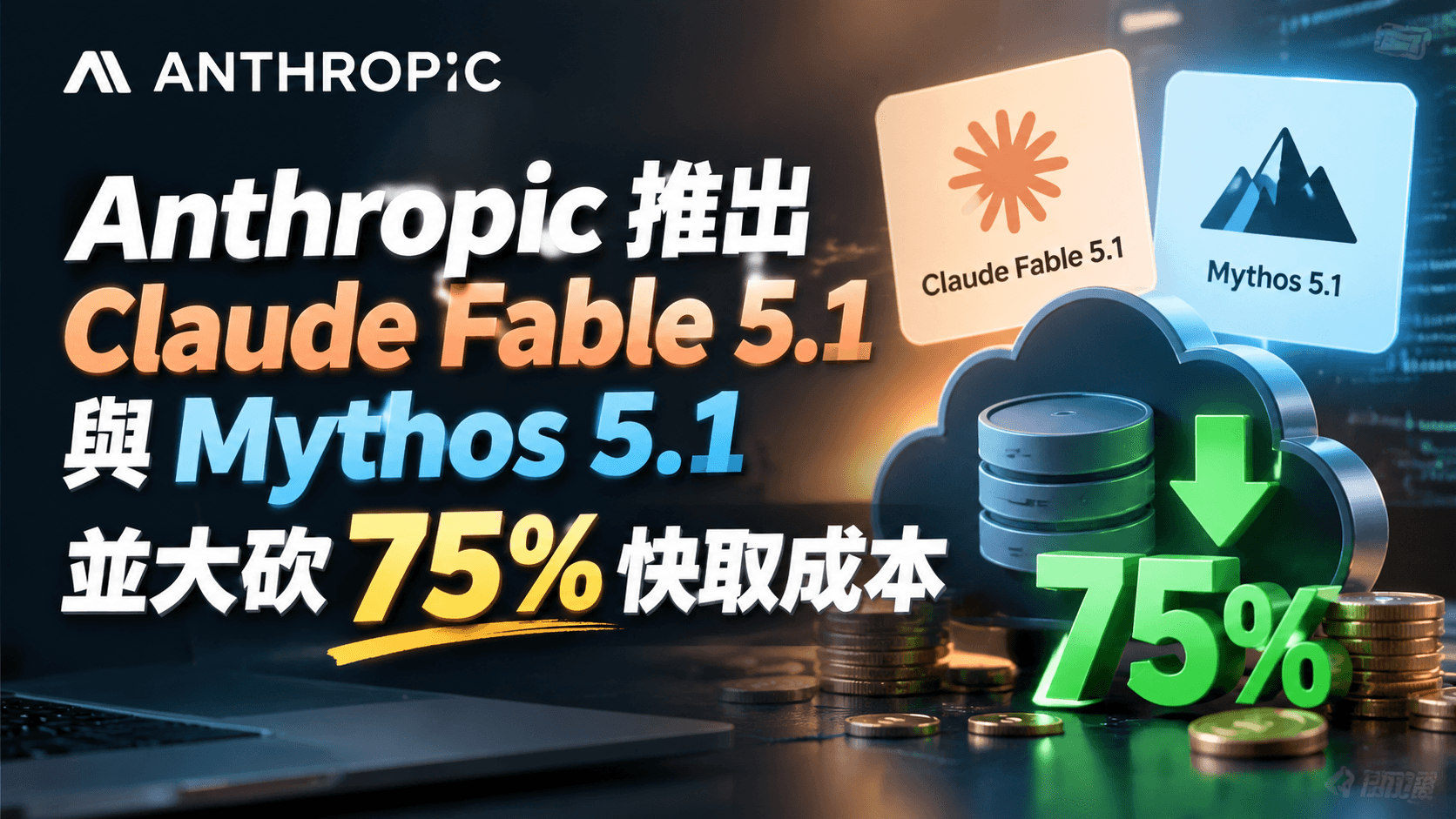
The focus of competition in generative AI has officially shifted from pure conversation to long-task agents that can act on their own (agentic AI). Anthropic today officially released its new flagship model Claude Fable 5.1 and a top-tier version for trusted-access environments, Claude Mythos 5.1, announcing major breakthroughs in complex software engineering, deep knowledge work and multi-step autonomous decision-making. The upgrade not only sets new industry benchmarks for terminal agent tasks but also precisely targets the most critical pain points for enterprise adoption: "inference cost" and "overly cautious safety false positives."
For Taiwan's tech industry, which is deeply invested in cloud-native work and digital transformation, the most striking part of this release is Anthropic's announcement that it is cutting Prompt Cache read (cache-read) prices by 75%. This dramatic pricing change effectively removes a steep financial barrier for high-frequency AI Agent workflows that constantly feed in large codebases and huge amounts of internal company information, quickly turning autonomous software engineering agents from expensive experiments into standard productivity infrastructure with a high return on investment.
Key takeaways
- Anthropic launched the new Claude Fable 5.1 and Mythos 5.1, focused on long-task agents, software engineering and advanced knowledge work.
- On the Terminal-Bench 4.0 benchmark, Fable 5.1 scored 55.8% and Mythos 5.1 reached 60.9%, far above the previous Fable 5's 24.7%.
- Prompt Cache read prices were cut by 75%, greatly reducing the long-term running costs of multi-turn conversations and terminal agents.
- Safety filtering in Claude Code was fully tuned, and the models launched at the same time on the AWS Bedrock and Microsoft Azure cloud platforms.
A leap in terminal agent performance: the compute jump on Terminal-Bench
Claude Fable 5.1 scored an excellent 55.8% on Terminal-Bench 4.0, a benchmark that simulates real terminal work, showing strong adaptability across multi-step environments and precise code editing. Compared with the previous Fable 5's score of just 24.7%, the new architecture more than doubled its performance, proving that Anthropic has made key breakthroughs in tuning its algorithms for long-context state tracking and terminal command parsing. Even more impressive is the trusted-access version, Claude Mythos 5.1, whose score shot up to 60.9%, setting the current performance ceiling for automated software agents.
On Terminal-Bench-Science 0.1, which focuses on cross-disciplinary computation, Fable 5.1 also scored a high 52.6%. This means the model can not only write and debug software in ordinary server environments but also understand complex scientific data pipelines, run multi-stage mathematical analyses and automatically fix runtime errors. This shift from simple code completion to fully autonomous problem-solving means future software engineers will be able to hand more architecture validation to the model, greatly shortening development cycles.
A 75% cut in cache costs: reshaping enterprise AI economics
Anthropic's 75% cut to Fable 5.1's Prompt Cache read costs completely breaks the cost shackles on complex long-context applications. Under the traditional pricing of large language models, software engineering agents have to resend tens or even hundreds of thousands of lines of code context every time they run a command, so API costs balloon exponentially with the number of conversation turns. The huge discount on cache reads lets developers preload large codebases or company knowledge bases into cache and then search and compute over them repeatedly at very low marginal cost.
This pricing change is especially good for Taiwan's industry, which is dominated by small and medium software teams and system integrators. When the cost of running high-performance long-task agents falls by three-quarters, companies building automated DevOps reviews, real-time log analysis and round-the-clock operations bots no longer have to compromise between model performance and context length because of budget limits, further accelerating the large-scale adoption of generative AI across industries.
Loosening over-defense: a practical upgrade for the developer tool Claude Code
Tuning the safety judgments of Claude Code, its dedicated terminal agent tool, shows Anthropic's practical rethinking of real engineering scenarios. In the past, overly sensitive keyword blocking and cybersecurity protections often misjudged legitimate penetration-testing scripts, low-level system calls or debugging commands as malicious attacks, frequently interrupting development. The new version keeps its core safety baseline while greatly reducing false positives in software engineering tasks, letting autonomous agents smoothly modify files, install packages and make network requests.
This rebalancing of safety and usefulness directly improves developers' trust in and flow when working with the model in the terminal. Engineers no longer need to spend extra effort writing complex prompts to get around overly defensive built-in guardrails, so Claude Code can reach its full potential in automated deployment, unit-test generation and large-scale refactoring.
Digital transformation in Taiwan: a strategic opportunity from cloud ecosystem integration
Claude Fable 5.1 launched at the same time on Anthropic's own Claude platform, Amazon AWS Bedrock and Microsoft Azure, giving Taiwanese companies the flexibility to deploy it seamlessly within their existing architecture. Whatever multi-cloud or hybrid-cloud strategy a company uses, it can call the latest model directly and connect it to private data pipelines while meeting data privacy and security compliance requirements. This same-day cloud ecosystem support effectively reduces the friction of migrating when companies adopt cutting-edge AI.
For Taiwanese companies actively investing in smart manufacturing, fintech and semiconductor supply-chain management, combining Mythos 5.1's advanced reasoning with Fable 5.1's cost-effective caching will make it possible to build more resilient enterprise intelligence hubs. From automated diagnosis of production-line logs to highly complex cross-source review of compliance documents, companies can set up autonomous agent systems that run around the clock and meaningfully advance high-value digital transformation.
Frequently asked questions (FAQ)
What is the main difference between Claude Fable 5.1 and Claude Mythos 5.1?
Claude Fable 5.1 is the main flagship model for businesses and developers at large, combining top reasoning performance with a very competitive cost structure. Claude Mythos 5.1 is an ultra-high-end version for specific trusted-access environments; it scored a top 60.9% on Terminal-Bench 4.0 and is designed for extremely complex long-chain research and high-precision software engineering.
What real difference does the 75% cut in cache read prices make for companies building agent applications?
The price cut greatly lowers the compute cost of multi-turn conversations and repeatedly loading large codebases, making long-task AI Agent architectures that frequently read past context very cost-effective to run commercially and effectively removing the financial barrier to adopting long-context, high-frequency applications.
Through which cloud channels can development teams access the new models now?
Besides calling them directly through Anthropic's official Claude API platform, development teams can enable Claude Fable 5.1 on the two major cloud services, Amazon AWS Bedrock and Microsoft Azure, and quickly integrate it into their existing enterprise servers and IT architecture.
The launch of Claude Fable 5.1 and Mythos 5.1 marks the generative AI industry formally entering a multi-dimensional race centered on "execution, economics and usability." Leading on benchmark scores alone is no longer enough to dominate the market; only by sharply lowering compute costs, making the defenses in developer toolchains practical and integrating closely with mainstream cloud ecosystems can truly evolve from an assistant chat tool into a company's core digital workforce. As autonomous agent technology keeps advancing, the future of tech competition will belong to the companies that can turn long-task models into real productivity advantages the fastest.