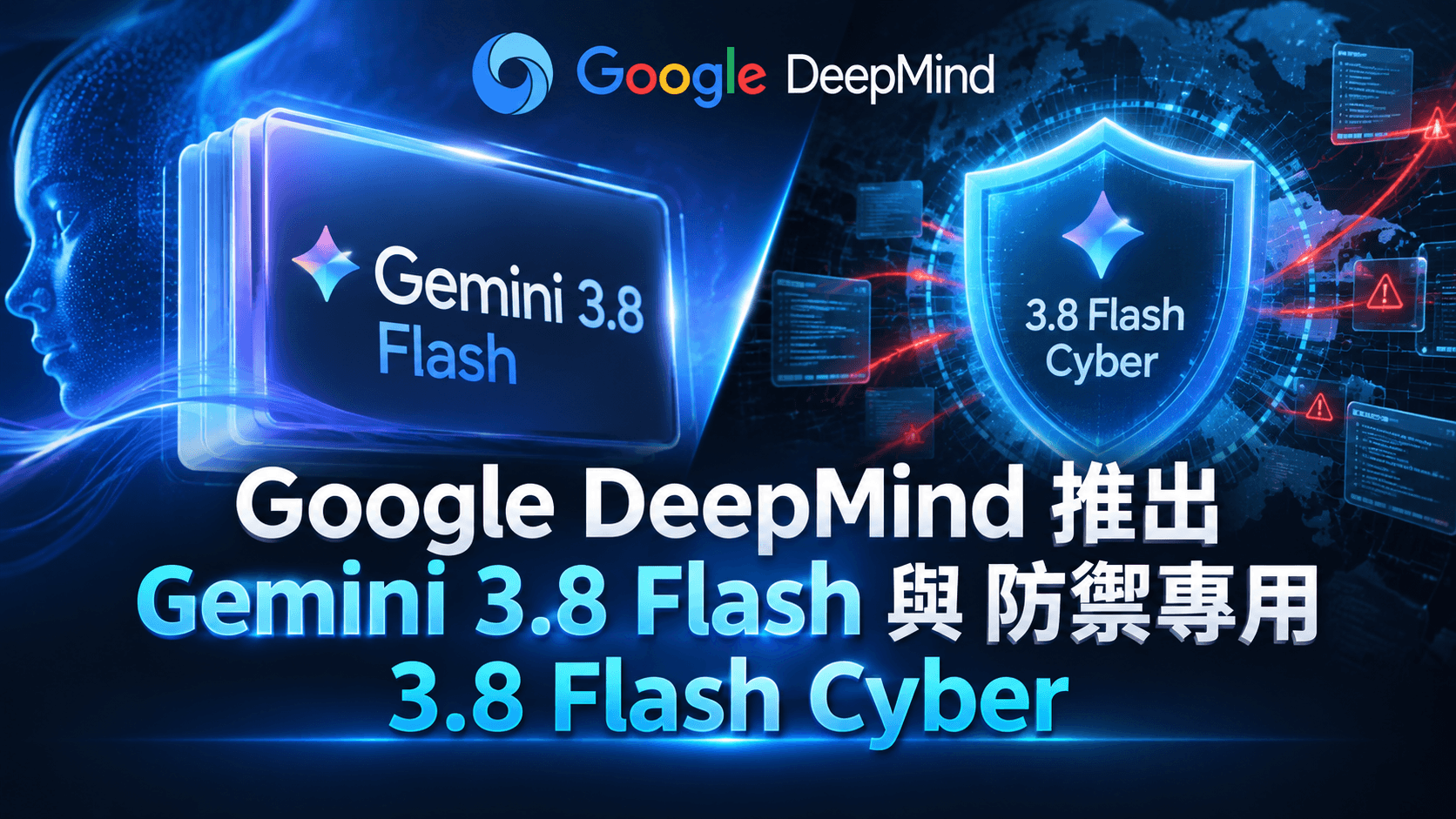
Google DeepMind recently made a splash with its new mainstream lightweight model Gemini 3.8 Flash and Gemini 3.8 Flash Cyber, built specifically for security, showing an astonishing pace of development. Remarkably, this major update came only about three weeks after the release of the previous Gemini 3.7 Flash, making it clear that generative AI model iteration has officially entered an ultra-fast era measured in "weeks." For software engineers and enterprise architects around the world, this is not just a jump in version numbers but a complete reshaping of modern cloud workflows and the limits of edge computing.
Gemini 3.8 Flash delivers a breakthrough leap in performance on software engineering, multi-step logical reasoning and autonomous AI Agent workflows. Through deep algorithm optimization, Google has made this lightweight flagship as robust as past heavyweight models when handling highly complex code refactoring and unstructured chains of logic. More importantly, the upgrade does not come with high compute costs; instead, its outstanding price-performance opens new possibilities for large-scale commercial deployment.
Facing increasingly serious digital security threats, the simultaneously released Gemini 3.8 Flash Cyber precisely targets the pain points of security defense teams. With a dedicated vulnerability-analysis architecture and automated threat mitigation, the model will become the first intelligent line of defense in modern enterprise server and network environments. This dual release shows that Google is no longer just chasing leadership on general metrics but strategically moving into high-value vertical areas at the core of enterprise operations.
Key takeaways
- Ultra-fast iteration: just three weeks after version 3.7, Google DeepMind officially launched Gemini 3.8 Flash.
- Outstanding price-performance: a 1 million token context window, with API pricing of just US$0.38 per million input tokens and US$1.88 per million output tokens.
- A specialized security line: Gemini 3.8 Flash Cyber was released alongside it, focused on system vulnerability analysis and threat defense.
- Ecosystem-wide launch: already integrated into Google AI Studio, Android Studio, Antigravity and Stitch.
Rethinking compute efficiency: the peak of price-performance for lightweight models
Gemini 3.8 Flash's highly competitive API pricing completely upends the cost structure of modern cloud services. At just US$0.38 per million input tokens and US$1.88 per million output tokens, developers building high-throughput multi-agent systems are no longer held back by heavy inference costs. Compared with similar solutions on the market, this pricing greatly lowers the barrier to deploying high-frequency tasks such as automated code generation, real-time semantic parsing and continuous conversation handling.
Its huge 1 million (1M) token context window is the model's killer advantage in engineering practice. Developers can feed an entire codebase, a massive technical white paper or hundreds of pages of company history into the model at once, without relying on complex retrieval-augmented generation (RAG) chunking algorithms that easily lose fidelity. This lets the model keep global coherence across long text while still responding with very low latency, truly striking a golden balance between speed and depth.
A dedicated defensive weapon: Gemini 3.8 Flash Cyber builds a security moat
Gemini 3.8 Flash Cyber is a specialized tool Google DeepMind built for enterprise network and server security. Traditional security information and event management (SIEM) tools often suffer from alert fatigue and lagging log analysis, while this model focuses on deep code auditing, finding vulnerabilities in microservices and identifying the signatures of zero-day attacks in real time. Security engineers can use its strong software reasoning to automatically reproduce threat paths and generate precise patch recommendations within seconds.
Embedding AI capabilities deeply into the security operations center (SOC) significantly shortens the mean time to respond (MTTR) when a company faces new attacks. By turning complex threat intelligence into actionable defense instructions, Gemini 3.8 Flash Cyber keeps security teams from being stuck on the back foot, letting them use predictive algorithms to close vulnerabilities before an attack chain forms and build proactive, resilient defenses for highly digitized modern companies.
Full ecosystem penetration: opportunities for Taiwan's tech industry
On launch day, Google rolled out Gemini 3.8 Flash across developer environments including the Gemini API, Google AI Studio, Antigravity, Android Studio and Stitch. For Taiwan's deep hardware-software integration industry and thriving digital marketing tech scene, direct integration with Android Studio means mobile app developers can get advanced intelligent completion and architecture suggestions right in their local development environment, greatly shortening time to market.
For Taiwanese companies facing the cost and technical barriers of high-end AI compute, Gemini 3.8 Flash offers a very attractive path to implementation. Whether deployed on multinational server infrastructure to analyze global customer service data or used for dynamic personalized recommendations on e-commerce platforms, the model's modest price and excellent reasoning give local companies a solid foundation for a real productivity edge in Asia-Pacific competition.
Frequently asked questions (FAQ)
What real benefits does Gemini 3.8 Flash's pricing bring to small and medium development teams?
Gemini 3.8 Flash's pricing of US$0.38 per million input tokens and US$1.88 per million output tokens greatly reduces the cost for small and medium teams to experiment with and run complex AI Agent and fully automated workflows, so even resource-limited startups can run enterprise-grade applications with million-scale token throughput at a very low cost.
Can Gemini 3.8 Flash Cyber directly replace existing enterprise antivirus and firewall software?
Gemini 3.8 Flash Cyber is positioned as an intelligent co-pilot for security experts, not a simple replacement for traditional endpoint protection tools. Its main value lies in deeply analyzing code security architecture, analyzing complex vulnerability logs and offering strategic defense recommendations. It complements existing perimeter protection software to build a multi-layered defense.
What are typical uses of a 1 million (1M) token context window in real software development?
Development teams can feed a complete project containing hundreds of thousands of lines of code, API specifications and test cases into the model at once to evaluate cross-module refactoring, detect dependency conflicts and analyze global performance bottlenecks, completely avoiding the risk of missing context that comes with traditional chunked retrieval.
The joint launch of Gemini 3.8 Flash and 3.8 Flash Cyber confirms that the AI market has moved from an arms race blindly chasing huge parameter counts to a mature stage focused on inference efficiency, economic viability and practical use in vertical domains. As Google DeepMind resets the technical benchmark at an astonishing pace of once every three weeks, how flexibly companies deploy lightweight, high-performance intelligent models on their digital transformation journey will become the key factor deciding who wins in the years ahead.