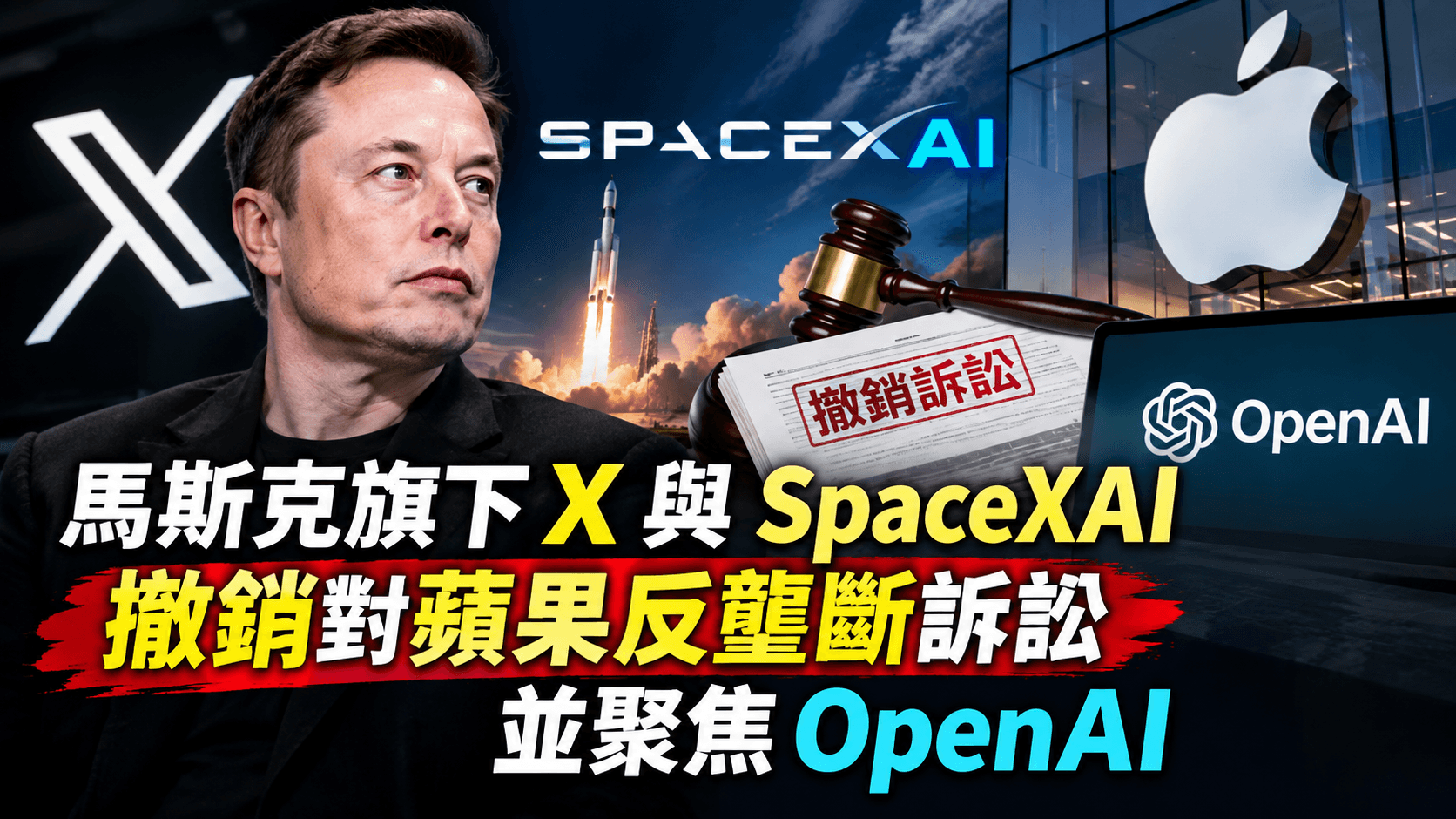
Legal battles between tech giants are often more dramatic than a Hollywood script. On September 14, Elon Musk's social platform X and AI company SpaceXAI formally filed dismissal papers in US federal court, ending their antitrust lawsuit against Apple. The tense legal fight, which accused Apple of unfair monopolistic conduct by deeply integrating ChatGPT into iOS, came to an end after the two sides reached a settlement, showing Musk's precise calculation between business reality and courtroom strategy.
Dropping the suit does not mean Musk is backing down across the board; it is a key turning point in which his AI empire "concentrates its firepower." Public court filings make clear that despite the settlement with Apple, X and SpaceXAI have not withdrawn their claims against OpenAI. Instead, they are recalibrating all their litigation resources to launch an all-out antitrust offensive against the AI leader run by Sam Altman in both consumer and enterprise markets. This marks competition in generative AI shifting from a cross-industry free-for-all to head-to-head combat between model developers.
For the global digital ecosystem and tech industry, the dismissal means Apple has successfully protected the gateway to its huge smart-device ecosystem, while also making it clear that on the ultimate battlefield of cloud computing and algorithms, Musk's real target has always been OpenAI. How will this litigation reshuffle affect global cloud server deployment and app distribution? The business logic behind it deserves a closer look.
Key takeaways
- Ending the Apple lawsuit: on September 14, X and SpaceXAI formally dropped their antitrust claims against Apple and reached a settlement.
- Focusing on OpenAI: litigation resources have shifted entirely to pressing legal action against OpenAI's alleged monopoly in consumer and enterprise markets.
- A shift in ecosystem strategy: the channel attack on iOS's integration of ChatGPT is over, replaced by a direct strike at the core generative AI competitor.
The calculation behind the litigation reshuffle: from all-out war to precision strikes
Overextending the front line has always been a cardinal mistake in war, and Musk's choice to make peace with Apple reflects a highly pragmatic business strategy. In the earlier lawsuit, Musk accused Apple of deeply binding OpenAI's ChatGPT into iOS, iPadOS and macOS, allegedly using its closed operating-system ecosystem to build anticompetitive barriers. But taking on both the world's most valuable hardware giant and today's most influential AI unicorn at the same time would inevitably spread his legal and marketing resources thin. By dropping the suit against Apple, Musk not only defuses potential friction over his apps' listings on Apple's App Store but can also focus the legal fight on the core dispute of whether OpenAI has abandoned its original open-source, nonprofit mission.
In practical legal terms, suing a platform operator and suing a direct algorithmic competitor are very different arguments to make. Proving that Apple's integration of particular software is an illegal monopoly requires clearing a very high evidentiary bar under current US antitrust law, because platforms usually have commercial discretion to choose their built-in partners. By contrast, focusing on OpenAI's market conduct, intellectual property licensing and path to commercialization is more likely to hit the rival's commercial weak spots. The legal adjustment lets SpaceXAI concentrate its top legal team on a more damaging offensive against OpenAI's market dominance in federal court.
Ecosystem coopetition and the channel game: the triangle of Apple, OpenAI and xAI
The value of device gateways is the lifeblood of traffic for every large language model, which is the fundamental reason Apple has become a battleground for every major AI company. In rolling out Apple Intelligence, Apple adopted a hybrid architecture that balances on-device privacy with cloud server flexibility, using third-party large models as optional add-ons. Musk's strong initial backlash essentially stemmed from anxiety that OpenAI had been first to claim the screens and default system channels of billions of high-end smartphones worldwide. Dropping the suit now suggests the two sides may have privately reached some understanding on opening technical interfaces or on compliance, leaving room to negotiate future entry of xAI's models into Apple's ecosystem.
For OpenAI, losing Apple as a co-defendant and legal buffer means it must bear the full antitrust pressure from Musk's camp alone. The generative AI industry is at a key point as it moves from a technology boom to commercialization, and competition in both enterprise API services and subscription consumer markets is shifting fast. Musk is speeding up iteration of his own large models using the real-time data stream from social platform X and his dedicated high-performance computing clusters. This two-way battle for algorithmic dominance has officially entered an open, head-on phase.
Key lessons for Taiwan and the global tech supply chain
This shift in a cross-border legal battle sends a far-reaching market signal to Taiwan's supply-chain companies, which sit at the core of global AI hardware. As Musk turns his full attention to fighting OpenAI, the arms race among tech giants over dedicated AI infrastructure and advanced-process chips will only intensify. Taiwan's semiconductor manufacturing, advanced packaging and high-performance computing server makers will keep benefiting from the huge capital spending of a diverse customer base on compute. Whether it is the Microsoft and OpenAI alliance or Musk's compute centers, demand for top-tier computing hardware is exploding.
In software and digital marketing, the change is also a reminder for Taiwanese companies to keep their architecture flexible and diverse when evaluating AI solutions. Relying too heavily on a single model vendor or ecosystem can expose them to operational risk in future copyright litigation and antitrust regulatory storms. Companies that can integrate across platforms and flexibly use different cloud architectures will gain a firmer competitive edge in the next phase of digital transformation.
Frequently asked questions (FAQ)
Why did Musk choose this moment to drop the antitrust lawsuit against Apple?
Musk settled with Apple and dropped the suit mainly to optimize how he allocates legal resources, avoiding spreading his firepower thin by also fighting hardware giant Apple, so he can concentrate all his legal and business resources on fighting the expansion of direct competitor OpenAI in the consumer and enterprise AI markets.
Does dropping this lawsuit mean Musk has given up his claims against OpenAI?
Not at all. Court filings clearly state that X and SpaceXAI dropped only the case against Apple; the antitrust lawsuit and related legal action against OpenAI are still moving forward and have even become the Musk camp's central litigation focus in AI.
How does this affect ordinary users' experience of AI features on Apple devices?
For ordinary users, dropping the suit removes legal uncertainty over iOS integrating third-party AI services, ensuring features such as ChatGPT keep working reliably in Apple's ecosystem, while potentially opening the door to future cooperation that brings other competitive models (such as Grok) to Apple devices.
Conclusion: the AI battle becomes trench warfare
Musk dropping his suit against Apple is not a compromise but a regrouping of forces with the bigger picture in mind. The future fight for AI dominance will no longer be just about who grabs the operating-system gateway, but a contest of hard power: algorithmic depth, data quality and computing efficiency. As the legal front lines become clearer, the global tech industry will witness an even fiercer, and purer, showdown at the peak of generative AI.