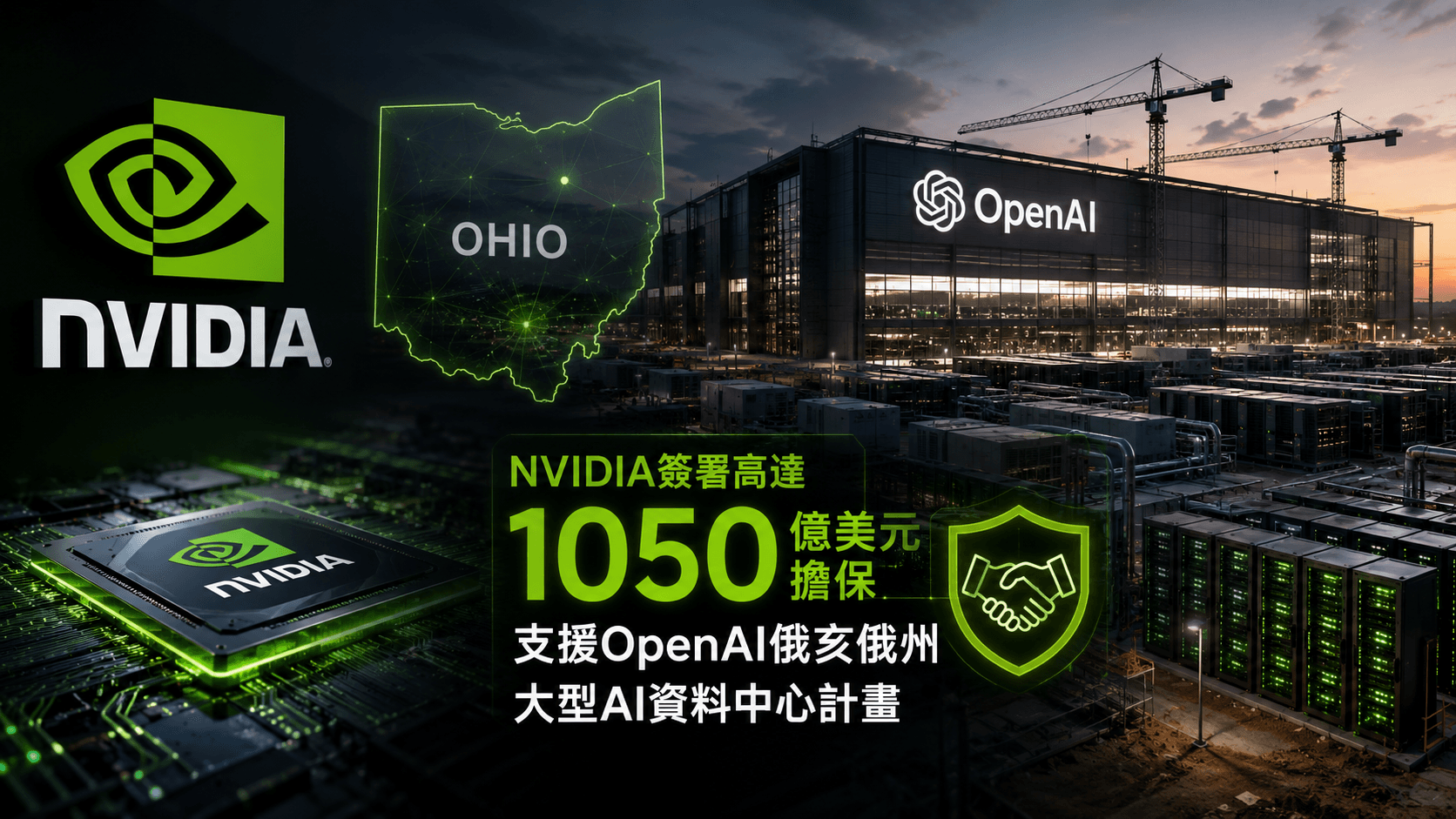
Nvidia is doing something chip companies have never done before: taking on debt risk for its own customer. On August 17, 2026, Nvidia announced it will provide up to US$105 billion in financial guarantees to help OpenAI lease and operate a large AI data center in Ohio. This isn't a simple purchase order or a typical strategic investment. It's a financial engineering deal that bets a chip supplier's credit directly on a model developer's future cash flow. When a hardware company is willing to use its own balance sheet to back a customer's lease, the signal to the market is clear: compute is no longer a problem that quarterly orders can solve.
The data center's developer is just as interesting. It's being built by SB Energy, part of SoftBank, with power demand expected to reach the multi-gigawatt (GW) level, making it one of the largest AI compute hubs in the world. In other words, the key players in this deal aren't just chips and models but also power and land. From grid connection, substations and energy storage to liquid cooling for server racks, the entire supply chain is packed into a single contract, and Nvidia's guarantee is the key lubricant that lets this chain secure low-cost financing.
For Taiwanese readers, this news carries far more weight than a US corporate financial announcement. Taiwan's server manufacturers, cooling module makers, power supply makers and advanced packaging companies sit right at the downstream end of this US$105 billion. As US funding structures are redesigned into long-term leases that "use compute as collateral," the nature of the orders Taiwan's supply chain receives will gradually shift from one-time hardware shipments to multi-year, predictable, but harder-to-exit long-term commitments.
Key takeaways
- Nvidia is providing up to US$105 billion in financial guarantees to support OpenAI's lease of an Ohio AI data center.
- The developer is SoftBank's SB Energy, with power demand at the multi-gigawatt (GW) level.
- Announced on August 17, 2026, it will become one of the world's largest AI compute hubs.
- The goal is to make sure OpenAI has the compute foundation to train its next-generation flagship models.
Breaking down the technology and engineering: not a server room, but a smart factory next to a power plant
To understand the scale of US$105 billion, you first have to translate it into engineering terms. Multi-gigawatt power demand is equal to the output of several large nuclear reactors. That's no longer the scale of a traditional cloud provider "renting a floor of a data center" but an infrastructure project that has to plan power transmission and distribution together with utilities. SB Energy's role is critical precisely because it has both energy development and land acquisition capabilities. The real bottleneck for AI data centers has never been buying servers. It's getting power, waiting for substations and getting a slot on the grid connection schedule.
On the hardware side, a campus this size will inevitably move fully to high-density racks and liquid cooling. Power per rack has jumped from just over ten kilowatts to more than a hundred kilowatts, traditional air cooling can no longer handle the heat flux of GPU clusters, and direct liquid cooling (DLC) and coolant distribution units (CDUs) have become standard. At the same time, the east-west traffic between tens of thousands of accelerators is forcing network design toward high-speed optical interconnects and low-latency switching, so the whole campus is logically treated as "one giant computer" rather than a collection of thousands of independent servers.
Even more notable is the tension between depreciation and generational turnover. AI accelerators go through a new generation about every one to two years, but a data center's physical life and lease often last more than ten years. This means the campus must be designed with spare power and cooling for the next generation of chips, or even the one after that. Otherwise, expensive concrete and power allocations will become a burden when hardware is upgraded. One implication of Nvidia's role as guarantor is that it knows the power curves of its own future products better than anyone, so it's better placed to assess the real risk of this long-term lease.
Market and business impact: a supplier guaranteeing its customer, a moat or a circular risk?
From a financial structure point of view, this is a textbook upgrade of "vendor financing." Nvidia isn't handing over US$105 billion in cash. Instead, it uses a guarantee to raise the credit rating of OpenAI's lease, making developers and creditors willing to fund capital spending at lower interest rates. For Nvidia, this locks in the purchasing pipeline of its biggest single customer for years to come at a relatively low balance sheet cost. For OpenAI, it's a ticket to long-term compute without immediately diluting its equity.
But the market's doubts are just as valid. When a chip supplier backs a customer's operating expenses, a circularity appears between revenue and credit risk: the customer's ability to pay is partly built on the supplier's guarantee. If next-generation models commercialize more slowly than expected, or inference costs fall sharply thanks to more efficient algorithms, this locked-in compute could end up in structural oversupply, and the guarantor would directly absorb the default gap. This is the most substantive technical argument in recent market debates about whether "AI capital spending is overheating," rather than emotional accusations of a bubble.
For SoftBank, this deal puts its dual energy and AI strategy into concrete action. By controlling power generation and land through SB Energy and then subleasing compute to model developers under long-term leases, SoftBank is effectively creating a new asset class: securitizable, cash-flowing "compute real estate" built on top of power. This also explains why global pension funds and insurance money have begun treating data centers as infrastructure investments rather than just an offshoot of tech stocks.
Strategic implications for Taiwan and Asia: more order visibility, but not necessarily more bargaining power
For Taiwan's supply chain, the most direct benefit is visibility. A multi-gigawatt campus means years of demand for server racks, power supplies, liquid cooling modules, chassis and high-speed connectors. Orders will come in annual frameworks rather than quarterly pulls, helping companies plan capacity and capital spending. Taiwan already has a sizable global share of AI server assembly and cooling solutions, and mega-projects like this can hardly bypass Taiwan's manufacturing capacity.
But visibility isn't the same as bargaining power. When end customers' compute purchases are highly concentrated among a few giants and a series of long-term contracts, the supply chain's pricing flexibility actually gets squeezed: the bigger the customer and the longer the project, the more pressure there is for cost transparency. The real opportunity for Taiwanese companies is to move up from "contract manufacturing shipments" to "system integration and energy efficiency consulting," packaging liquid cooling, power usage effectiveness (PUE) and rack-level integration into billable engineering value instead of just competing on assembly margins.
At the regional level, this deal also signals a reshuffling of the geopolitics of compute. As the US uses its capital and power advantages to concentrate mega training hubs, Asian markets will lean more toward inference and regional nodes driven by data sovereignty, and data center investment logic in Japan, South Korea and Southeast Asia will adjust accordingly. For Taiwan's cloud and software companies, this means the cost-effectiveness of building their own large training clusters will keep falling, and putting resources into vertical applications and data governance is the more practical choice.
Frequently asked questions (FAQ)
Why is Nvidia providing financial guarantees for OpenAI instead of investing directly?
A guarantee is more capital-efficient than a cash investment. By offering a credit guarantee, Nvidia can improve the financing terms of OpenAI's long-term lease without spending a lot of cash up front or diluting its own shareholders, speeding up the data center's construction and locking in future GPU purchasing demand. This vendor financing model also gives Nvidia more flexibility: it takes on contingent risk rather than an immediate hit to its balance sheet, while making sure its largest customer doesn't slow down compute expansion because of funding bottlenecks.
Will multi-gigawatt power demand put pressure on energy supply and electricity prices?
Yes, and that's the biggest practical challenge for projects like this. Several gigawatts is equal to the power use of a mid-sized city and directly affects local grid dispatch, transmission and distribution investment and peak load pricing, which is why the developer has to be SB Energy, a company capable of energy development. In practice, mega AI campuses usually need dedicated generation, energy storage and long-term power purchase agreements (PPAs) to keep costs stable, or swings in electricity prices could wipe out the project's entire financial model.
What real impact will this have on Taiwan's AI server supply chain?
In the short term, better order visibility. In the medium term, a shift in product mix. A multi-gigawatt campus will drive multi-year demand for high-density racks, liquid cooling modules, high-efficiency power supplies and high-speed connectors, and Taiwanese companies are the main beneficiaries. But as projects scale up, customers will also demand more cost transparency and consistent delivery. Whether Taiwanese companies can move up from pure contract manufacturing to offering full-rack system integration and energy efficiency optimization will decide how much margin they capture in the next round of competition.
Conclusion: the next race for compute is about financing structure
This US$105 billion guarantee marks the main battleground of the AI race officially shifting from chip performance to financing structure and energy access. Over the next eighteen months, we're likely to see more three-way setups where "chipmakers guarantee, energy companies develop and model makers lease," and even financial products backed by compute cash flows. What will really decide the winner is no longer just whose model scores higher on benchmarks but who can turn power into intelligence with the lowest cost of capital and the fastest grid connection. As for the risks of this gamble, the market will only settle the bill when the next round of model commercialization results comes in. Until then, Taiwan's server and cooling companies will probably be too busy to worry about a bubble.


