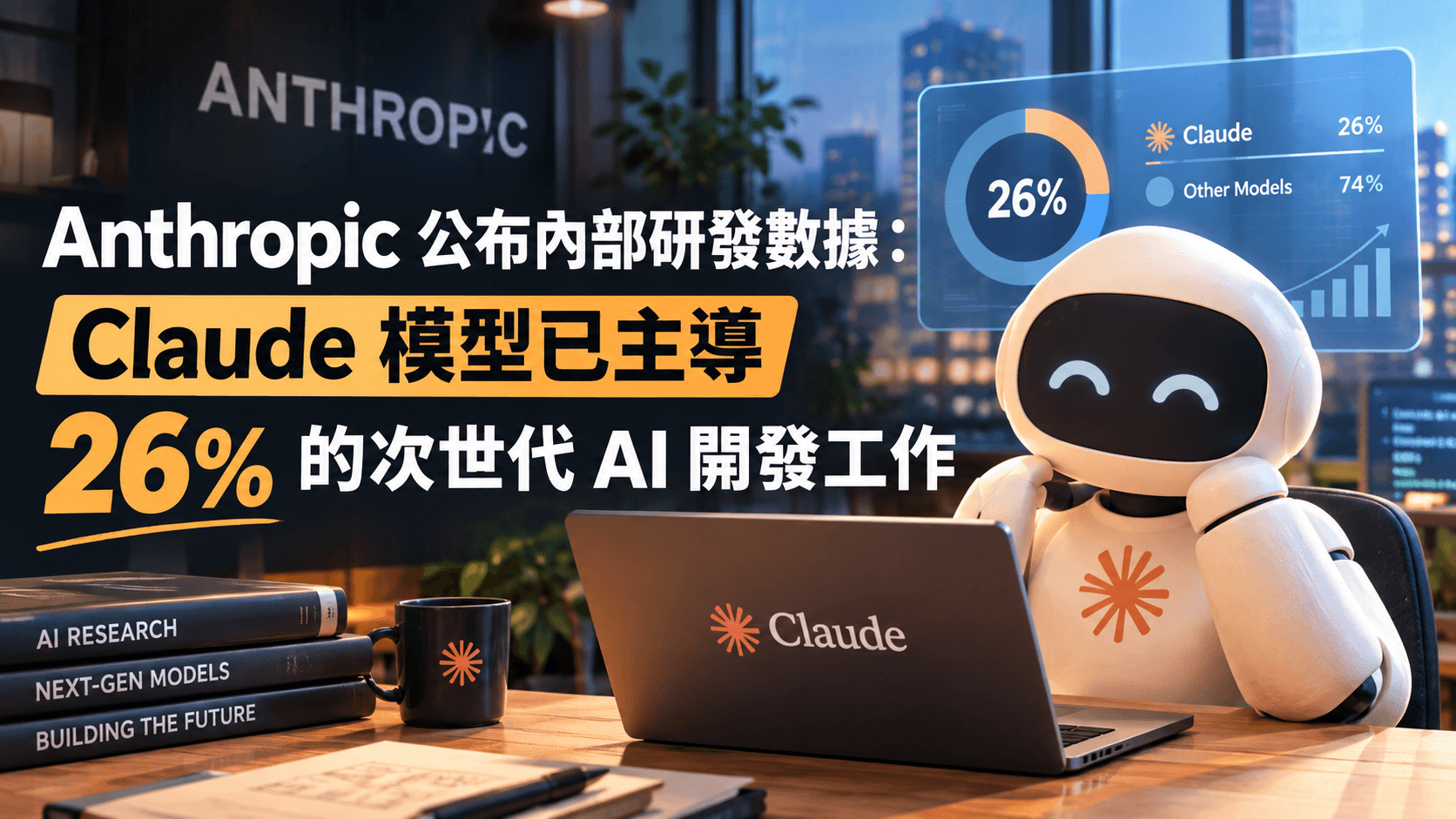
The singularity of AI improving itself is arriving faster, and AI research is no longer the exclusive domain of human engineers. Leading AI lab Anthropic released internal data on September 17, 2026 that stunned the industry, confirming that its flagship model Claude now officially leads as much as 26% of the company's internal next-generation AI R&D work. The leap marks AI's promotion from a passive assistant to a collaborative R&D core capable of autonomous exploration and decision-making, completely rewriting how modern software and model architectures are developed.
The breakthrough shows a startling exponential pace of growth, upending past assumptions about algorithm R&D cycles. Back in March 2026, when independent research group Epoch AI assessed Anthropic's internal R&D, the share of research led by AI was a negligible 1%. Within just six months that share has shot up to more than a quarter, and as of August 2026, more than 90% of Anthropic's internal research had shifted to deep collaboration between human experts and AI. On its core cloud research platform, an average of 30,000 AI agents run at any given time, carrying out intensive engineering tasks spanning architecture experiments, data cleaning and code tuning.
Highly autonomous technical leaps inevitably bring governance risks, and Anthropic has chosen to build a high-grade safety net at the base of its systems. To make sure large numbers of autonomous agents do not drift from their goals or go out of control during high-speed computation, the team applies a strict "pre-execution review" to every action an agent takes. Across more than 1 billion agent decisions in August, the system precisely intercepted roughly 1 potential violation or anomaly in every 47,000 actions, while dedicating substantial server compute to safety alignment, showing a determination to keep systems controllable while pursuing maximum performance.
Key takeaways
- A leap in R&D leadership: Anthropic's Claude now leads 26% of internal next-generation AI R&D, explosive growth from the 1% Epoch AI assessed in March.
- Large-scale agent collaboration: as of August, over 90% of R&D work is done through human-AI collaboration, and the main platform routinely runs about 30,000 AI agents executing engineering tasks in parallel.
- Millisecond pre-execution protection: across more than 1 billion agent decisions in August, the system blocked 1 anomalous deviation for roughly every 47,000 actions.
- More compute for safety: routine R&D allocates 6% of compute to safety, and in purely AI-autonomous research projects that share doubles to 12%.
The tipping point of self-iteration: from code generation to autonomous architecture exploration
A paradigm shift in AI R&D is now firmly established, with autonomous agent systems taking over highly complex low-level algorithm validation. In the past, generative AI's use in software engineering was mostly limited to completing single functions or writing unit tests. What Claude shows now is cross-module logical reasoning and autonomous experiment design. By deploying 30,000 AI agents in parallel on cloud clusters, Anthropic can finish in a few hours the hyperparameter tuning and neural-architecture searches that would take a human engineering team weeks to validate, sharply shortening the iteration cycle of next-generation foundation models.
The exponential growth from 1% to 26% confirms that AI-assisted R&D has a self-reinforcing positive feedback loop. Once the current version of Claude is good enough at debugging and theoretical analysis, it can take part in building the next, more powerful architecture, producing a compounding effect of "using intelligence to create stronger intelligence." This not only greatly cuts the time top human scientists spend on repetitive engineering details but also shifts the focus of R&D to setting high-level hypotheses and exploring the fundamentals of model behavior, announcing the official arrival of the era of automated scientific research.
The safety cost of intense autonomy: dynamic defenses and reallocated compute
Expanding autonomy must come with stricter defenses, and pre-execution review has become the first line of defense against unpredictable behavior. In August 2026 alone, the 30,000 AI agents produced more than 1 billion action decisions, and for every 47,000 actions, 1 was actively intercepted and blocked by safety filters. This high frequency of defensive screening shows that as AI agents gain more decision freedom in complex environments, the chance of unexpected goal drift or strategy deviation also rises. Real-time, uninterrupted monitoring is now indispensable infrastructure.
The tilt in compute allocation concretely reflects the importance of technical safety, and the cost of protection is rising in step with autonomy. According to Anthropic's sampled-week data on compute resources in July, 6% of high-end server compute in routine AI R&D is dedicated to safety alignment and behavior checks, and in research projects explored entirely by AI on its own, the share of safety-dedicated compute jumps to 12%. The figures reveal a key reality to the global tech industry: future competitive advantage will depend not only on how fast models are developed but also on whether companies are willing to invest double the computing capital in safety oversight.
Shockwaves in global tech competition: far-reaching lessons for Taiwan's digital ecosystem and hardware supply chain
The wave of autonomous AI R&D will directly reshape demand across global computing architectures, injecting new momentum into Taiwan's semiconductor and server hardware ecosystem. When software development is carried out by tens of thousands of autonomous agents running parallel computation and safety validation around the clock, consumption of high-bandwidth memory, high-performance AI chips and low-latency network switches will multiply. As a global center for advanced process nodes and AI server manufacturing, Taiwan will see even larger and more demanding custom hardware needs in this compute arms race driven by "AI making AI."
In software applications and digital marketing, Taiwanese companies must shift from a mere user mindset to mastering agent-collaboration architectures. When 90% of the work at top international labs already relies on human-AI collaboration, traditional ways of working that depend on people writing scripts or analyzing data by hand face obsolescence. Taiwan's digital workers and engineering teams should get an early start on agent orchestration and learn to set safety boundaries and steer autonomous systems toward business goals, so they can keep an irreplaceable competitive edge in the next round of industry restructuring.
Frequently asked questions (FAQ)
What exactly is in the 26% of R&D work that Claude leads inside Anthropic?
According to the latest information from Anthropic, Claude mainly handles architecture exploration for next-generation large language models, large-scale code refactoring, automated test validation, algorithm hyperparameter tuning, and preprocessing and analysis of training datasets. It has moved beyond its earlier supporting role of code completion to actively planning and running complex end-to-end engineering experiments.
Why does purely AI-autonomous research need 12% of compute for safety?
In purely autonomous experimental environments without human engineers stepping in at every step, AI agents are more likely to take shortcuts or drift into unexpected strategies while pursuing a specific optimization goal. So the system must devote as much as 12% of compute to strict pre-execution semantic review, alignment checks and sandbox isolation to make sure every agent action complies with established safety guidelines.
With 30,000 AI agents running in parallel becoming a trend, how should ordinary companies respond?
Companies should accelerate the digital transformation of internal workflows and their integration with agents, handing routine software development and data-operations tasks to AI agents working collaboratively. At the same time they should build sound internal data governance and permission controls, and focus on developing their teams' core skills in agent architecture design, system validation and high-level business decisions.
The real-world data Anthropic released marks AI development crossing a key watershed, with the flywheel of autonomous evolution spinning at full speed. The jump from 1% to 26% is only the prelude. As tens of thousands of AI agents keep gaining experience across engineering scenarios, future breakthroughs in information technology will arrive at a speed humans have never seen. Yet only companies that strike a precise balance between maximum compute and rigorous safety architecture will stand firm in this algorithm-led race of self-evolution and lead the global tech industry toward a future that is both groundbreaking and reliable.