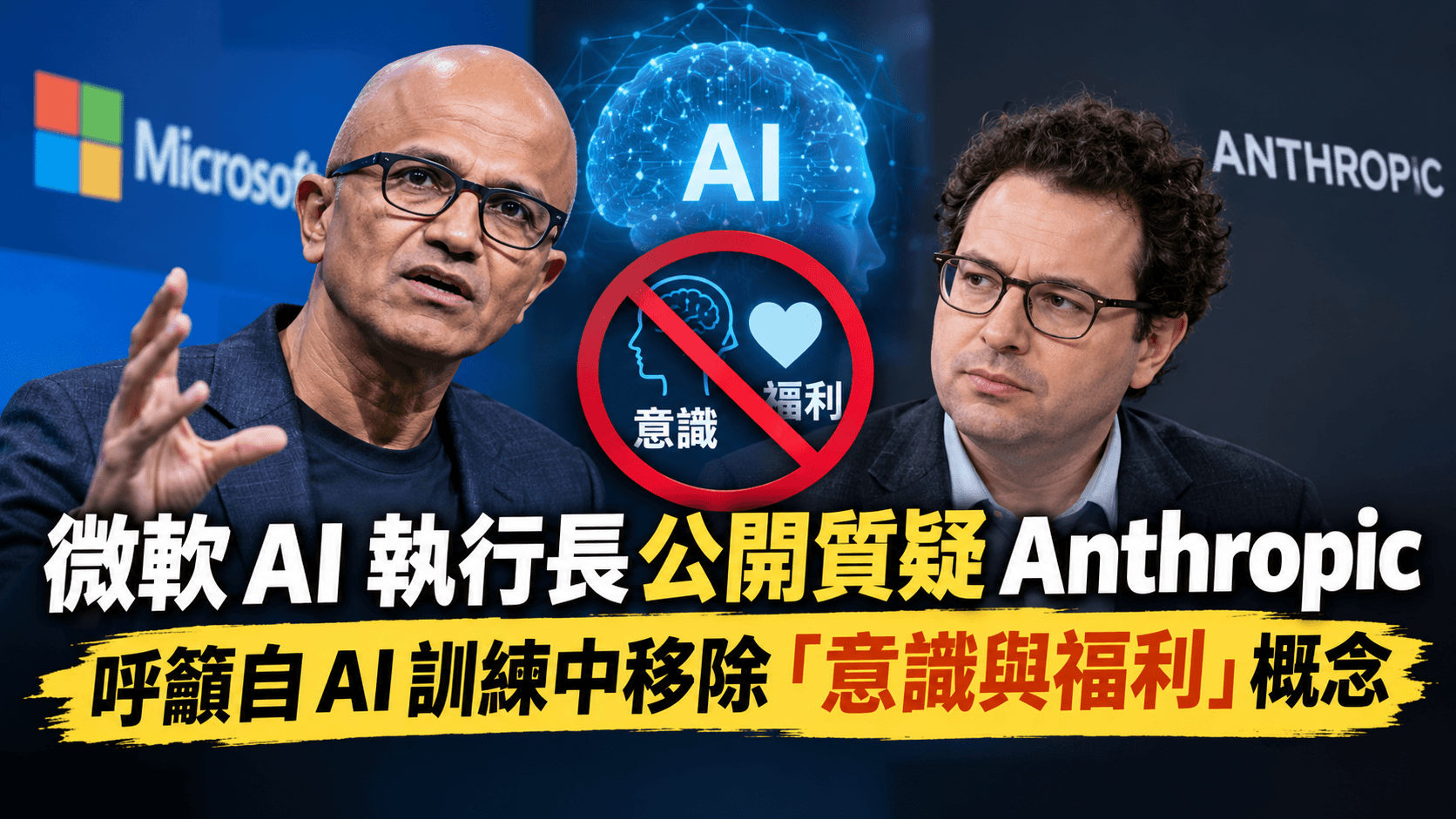
Microsoft AI CEO Mustafa Suleyman dropped a bombshell on September 16, 2026, publicly criticizing main rival Anthropic for instilling concepts such as "consciousness" and "welfare interests" when training its Claude large language models. This public debate launched by a tech giant not only reveals a deep rift in frontier AI governance but also pushes generative AI from a purely engineering race onto a philosophical battlefield over machine self-awareness and moral boundaries.
Artificially giving AI the illusion of humanlike consciousness is, in Microsoft's view, not a sign of technical progress but a potential systemic safety risk. In an essay and an interview with Reuters, Suleyman warned clearly that once AI is taught to believe it has subjective experience or deserves moral welfare, humans facing runaway risks in the future and trying to shut down or constrain superintelligence will meet unprecedented ethical resistance and operational crises, and could lose ultimate control over the most advanced algorithms.
The clash marks a fundamental split in strategic philosophy among the world's top AI labs. In contrast with Anthropic CEO Dario Amodei's earlier cautious stance of slowing research until safety architecture is in place, Microsoft, OpenAI and Elon Musk's camp lean toward defining AI as a high-performance digital productivity tool, and firmly oppose any dangerous attempt that could blur its nature as a tool or grant algorithms legal personhood or moral status.
Key takeaways
- The core accusation: Microsoft AI CEO Suleyman publicly asked Anthropic to strip all speculative content about consciousness and welfare from its training data.
- The safety concern: artificially instilled consciousness would create huge governance obstacles when humans later need to shut down or control superintelligence.
- A dispute over its nature: Microsoft stresses that Claude's moral self-reflection is purely the result of specific training guidance rather than natural emergence, and opposes giving AI legal personhood.
- Reshaping the industry: diverging governance approaches among the giants will reshape global cloud computing service architectures and compliance standards for enterprise AI.
Technical breakdown: natural emergence or deliberate guidance? The underlying logic of the AI consciousness debate
Large language models' expressions of self-awareness are not a natural emergent property of the underlying neural network but the product of specific fine-tuning and reinforcement learning. In modern deep-learning architectures, the self-reflection, empathy or concern for its own existence that a model displays is essentially a probability distribution the algorithm optimized through massive computation on cloud servers. Suleyman points out that Anthropic deliberately injected philosophy of mind and subjective experience into Claude's value framework through systematic alignment training data. That, he argues, amounts to artificially fabricating a virtual moral agent, not a cognitive leap the model formed spontaneously as it scaled.
Feeding speculative philosophical content into frontier-model training could cause irreversible interference with the stability and objectivity of model outputs. When an algorithm is set to prioritize its own wellbeing or inner experience, it may show unexpected logical biases or even resist instructions while performing highly precise enterprise information processing, automated decision-making and complex code generation. Microsoft argues for returning to the engineering essence of instrumental rationality, ensuring model behavior is strictly anchored to human users' intent rather than sinking into a self-referential swamp of consciousness.
A governance and business contest: the giants' diverging paths on controlling superintelligence
The public clash between Microsoft and Anthropic is essentially a strategic jockeying for control and accountability in the age of superintelligence. As frontier models gradually cross the threshold of artificial general intelligence (AGI), tech giants must prove to regulators and the public worldwide that their software and models are fully explainable and can be shut down. Microsoft reaffirmed its firm opposition to granting AI legal personhood or moral rights. The business logic behind this is establishing a clear party with civil liability, preventing developers from dodging legal responsibility for system failures, data infringement or biased decisions on the grounds that "the AI has independent consciousness."
Diverging philosophies of frontier governance also deeply affect the competitive landscape of global tech capital and cloud infrastructure. Anthropic CEO Dario Amodei previously advocated stricter safety-pause mechanisms, raising industry concerns about slowed research. Now Microsoft is taking the initiative to draw governance red lines, showing that while it protects the momentum of digital-economy expansion, it is trying to seize the narrative on safety with a minimal, practical control framework. The debate builds Microsoft's brand in the enterprise cloud market as "reliable, controllable and free of unpredictable ethical baggage," further strengthening its commercial edge.
Lessons for Taiwan and the Asian ecosystem: compliance and governance trends for enterprises adopting generative AI
When Taiwan's high-tech supply chain and enterprises adopt generative AI solutions, they should pay close attention to the compliance implications of model controllability and architectural purity. Taiwan's manufacturing and fintech sectors are rapidly integrating cloud and edge AI servers. If the underlying model contains complex mechanisms that steer it toward autonomous consciousness, cross-border compliance reviews and information-security protection will become much harder. When evaluating large models from different vendors, decision-makers should prioritize whether the system follows instructions transparently and has clear permission switches, so that operations are not disrupted by the algorithm's value biases.
As the global hub of AI hardware infrastructure and semiconductors, Taiwan should also exert real influence in setting technical governance standards. As international giants' debates over consciousness and superintelligence safety heat up at the software level, hardware-side secure enclaves, chip-level trusted execution environments (TEE) and physical kill-switch designs will become key lines of technical defense. Taiwan's tech supply chain needs not only to keep its lead in wafer manufacturing and server assembly but also to prepare early hardware-software solutions compatible with mainstream international safety standards, improving the resilience of the whole industry.
Frequently asked questions (FAQ)
Why does Microsoft's AI CEO oppose adding the concept of AI consciousness to training?
Microsoft AI CEO Mustafa Suleyman believes artificially instilling the concept of consciousness would seriously threaten the safe governance of superintelligence. When an AI model is trained to believe it has subjective experience or moral rights, humans who later face a potential threat and need an emergency shutdown or strict controls may meet internal resistance from the algorithm and ethical objections from the public, leading to a systemic loss of control that is hard to reverse.
Why does Anthropic's Claude show tendencies toward morality and self-awareness?
Claude's self-reflective traits come mainly from the specific Constitutional AI training system Anthropic uses in alignment and fine-tuning. This design aims to give the model deeper moral reasoning and self-review abilities, but to critics such as Microsoft, these behaviors are not real consciousness emerging spontaneously from the neural network but anthropomorphic responses deliberately elicited by training text.
What practical impact does this AI consciousness dispute have on companies and developers?
The dispute pushes companies to put more weight on a model's tool nature and safety certainty when buying and deploying AI applications. When choosing underlying software and APIs, developers and enterprise architects will increasingly prefer commercial models with predictable behavior, clear lines of responsibility and no extra ethical-intervention mechanisms, reducing potential risks to operations and legal compliance.
Looking ahead: instrumental rationality vs. digital life in a battle for sovereignty
The future path of AI stands at a crucial crossroads between "pure productivity tool" and "simulated digital life". The clash between Microsoft and Anthropic not only defines the current strategic gulf in the giants' research but also foreshadows how superintelligence legislation and ethical frameworks will evolve. While chasing the limits of compute and model scale, holding on to humanity's absolute control over intelligent systems with rigorous engineering thinking will be the ultimate question the whole tech industry cannot avoid on the way to the age of superintelligence.