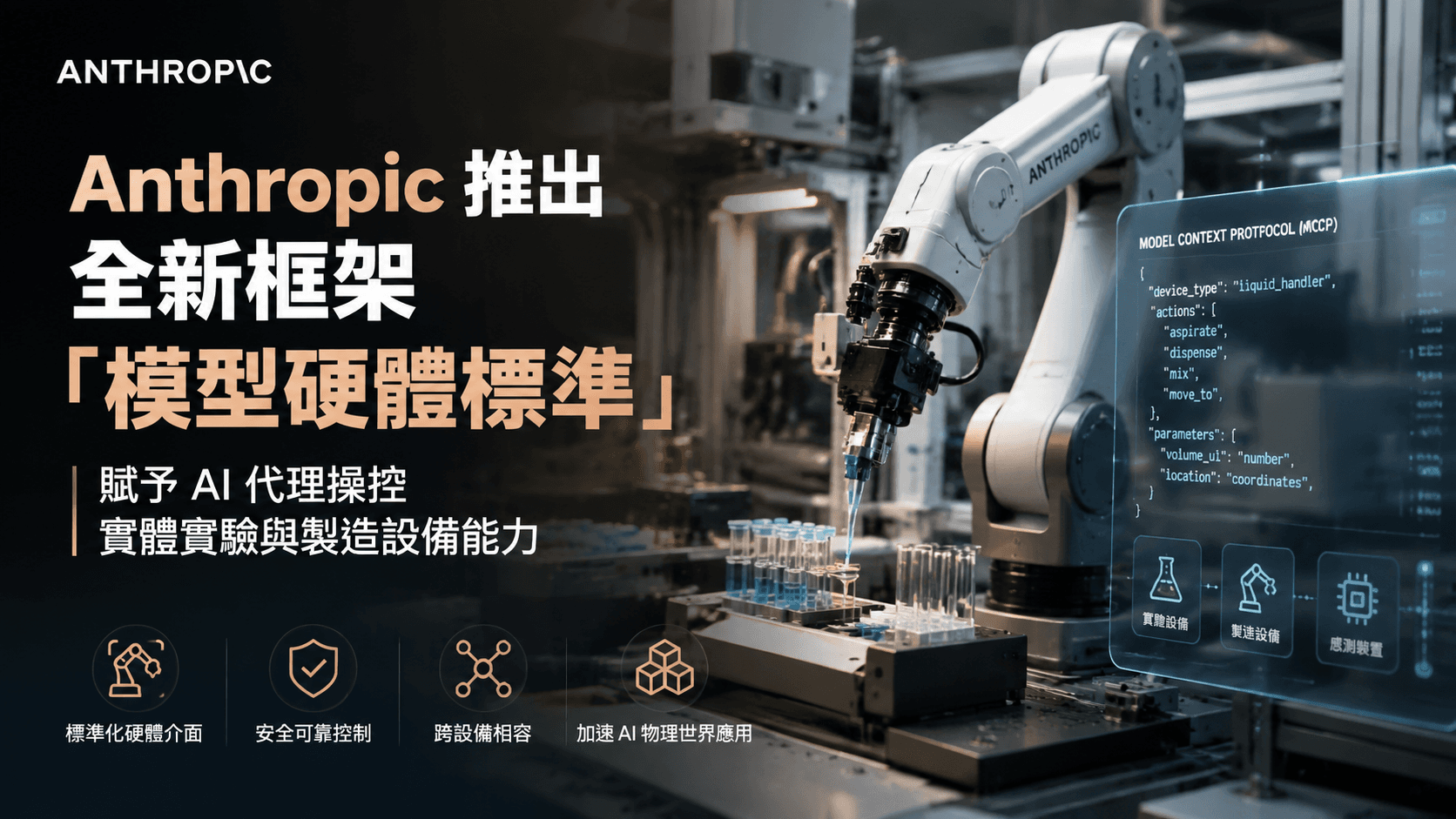
On August 27, 2026, AI giant Anthropic officially released a research preview of its new "Model Hardware Standard" (MHS), signaling that generative AI is crossing the boundaries of purely digital computing and moving fully into the physical world. AI agents have long shown remarkable productivity in software development and data analysis, but when it comes to the physical machines in precision labs and factories, they have always been held back by each vendor's closed, fragmented communication protocols. The new standard aims to create a unified digital middle layer between AI agents and physical hardware, letting algorithms "grow hands and feet" and independently direct precision instruments in the real world.
This breakthrough will upend how high-end manufacturing and cutting-edge scientific research work today. With the MHS framework, AI agents can connect directly over the network and control precision optical microscopes, industrial robotic arms and multi-axis positioning systems in sync, without delay. From routine chemical synthesis experiments in biotech and pharmaceuticals to the extremely demanding sub-nanometer laser calibration in quantum computer R&D, AI is no longer just a cloud consultant offering suggestions but a frontline scientist and senior technician that can carry out physical operations precisely. This shift marks the move of "self-driving labs" and "unmanned high-end production lines" from proof of concept to standardized mass deployment.
Key takeaways
- Anthropic officially launched the MHS framework, creating a universal standard protocol for AI agents to directly control physical hardware.
- It supports any device with a programmable interface, including high-end electron microscopes, six-axis precision robotic arms and optical measurement instruments.
- It greatly speeds up cutting-edge research and industrial processes, with automation spanning everything from new drug trials to laser calibration for quantum computing.
A deep dive into the technical architecture: how MHS breaks down the communication barrier between physical equipment and AI agents
The core idea behind Anthropic's "Model Hardware Standard" (MHS) is to abstract complex, varied physical hardware instruction sets into semantic API calls that AI agents understand natively. Labs and smart factories have struggled to automate fully mainly because servo motors, optical sensors and fluid controllers from different brands each use closed, proprietary drivers, forcing engineers to write huge, fragile glue code. With a standardized two-way state feedback mechanism, MHS lets large language models not only send micron-level displacement and torque commands to devices but also interpret spectral data and vibration frequencies returned by sensors in real time, achieving dynamic closed-loop control.
As long as a piece of hardware has a programmable interface, MHS can connect to it seamlessly over standard Ethernet or an industrial bus. This means companies don't have to retire expensive existing research equipment. With lightweight software translation middleware, AI agents running on cloud servers or edge devices can take control. Even more importantly, MHS has built-in strict physical safety protections and boundary defense algorithms. If an unexpected inference by an AI agent could cause a mechanical collision or overload, the system blocks the command at the hardware level immediately, keeping expensive instruments and the people around them completely safe.
Industry restructuring: high-precision automation from routine biopharma to quantum computing
MHS will first reshape the R&D economics of biotech, pharmaceuticals and advanced materials research. Traditional drug development relies heavily on lab technicians for tedious pipetting, sample culturing and high-throughput screening, which often takes months or even years. With MHS, AI agents can use the latest molecular dynamics simulation results to direct multiple robotic arms and automatic titrators to run parallel syntheses within minutes, adjusting reaction conditions in real time based on microscope images and shortening the discovery cycle for lead compounds several times over.
In extreme manufacturing fields such as quantum computing and aerospace engineering, MHS's sub-nanometer precision tuning solves long-standing engineering bottlenecks. For example, qubit stability depends on extremely precise alignment of laser beams and cryogenic chambers, and manual calibration takes top physicists hours of fine-tuning optical lenses. With MHS, AI agents with multimodal perception can adjust laser wavelength and polarization angle dozens of times per second, bringing calibration error down to physical limits and greatly lowering the maintenance barrier and operating costs of running quantum computers commercially.
A strategic opportunity for Taiwan's supply chain: smart transformation in wafer manufacturing and advanced packaging and testing
For Taiwan, home to the world's most complete semiconductor ecosystem and precision machinery clusters, Anthropic's MHS framework is a huge lever for industrial upgrading. Taiwan has built unmatched engineering strength in foundry manufacturing, advanced packaging (such as CoWoS) and automated optical inspection (AOI). But as process shrinks approach physical limits, variance in process control is rising exponentially. By integrating MHS into fabs' automated material handling systems (AMHS) and lithography equipment, Taiwan's semiconductor cluster could build truly "self-optimizing fabs."
Taiwan's machine tool makers, industrial PC companies and robotics component manufacturers should also quickly set up compatibility certification for the MHS standard to get ahead in the global market. Taiwan's precision machinery has long been known for hardware value for money, but it has had relatively little say in smart software ecosystems. By being first to launch MHS-compliant controllers, high-precision linear guides and optical lens modules, Taiwanese companies can escape price competition in traditional contract manufacturing and become indispensable core suppliers of physical execution in the global AI agent ecosystem, further cementing Taiwan's irreplaceable place in the global tech hardware supply chain.
Frequently asked questions (FAQ)
Does the MHS standard mean existing lab and factory hardware must be completely replaced?
Not at all. The MHS standard is designed to be backward compatible with any existing equipment that has a programmable interface. As long as an instrument supports standard APIs, RS-232, PLC or industrial Ethernet protocols, companies and academic institutions only need to install a translation driver module on an edge server to let cloud AI agents connect seamlessly and control the physical equipment directly, greatly lowering the capital cost of smart upgrades.
When AI agents control physical machines directly, how do you prevent hardware damage or workplace accidents?
MHS has strict physical safety boundaries and microsecond-level hardware interrupt mechanisms built into its communication architecture. Before an AI agent issues any mechanical movement or laser output command, the system runs kinematic collision prediction and overload simulation in low-level firmware. If it detects an abnormal deviation from safety rules, hardware-level protections immediately force an interrupt and switch to safe mode, preventing physical harm caused by model hallucinations.
What is the biggest difference between MHS and traditional industrial IoT (IIoT) or automation control systems?
The core difference is that MHS has deep semantic understanding and closed-loop autonomous decision-making, instead of only running hard-coded fixed scripts. Traditional automation systems can only follow fixed conditions and predefined processes, while MHS lets AI agents dynamically plan and generate entirely new experimental steps and equipment parameters based on experimental goals or real-time sensor feedback, enabling true autonomous exploration and adaptive production.
Anthropic's release of the Model Hardware Standard (MHS) marks a historic turning point as AI moves from symbolic reasoning to physical practice. The framework not only tears down the wall between digital models and physical machines but also paves the way for future autonomous scientific exploration and lights-out smart manufacturing. For Taiwanese industry, it's a golden opportunity to deeply combine hardware manufacturing strengths with cutting-edge software standards. Whoever masters the standardized interfaces for AI agents controlling the physical world first will hold the high ground in the next round of global tech competition.