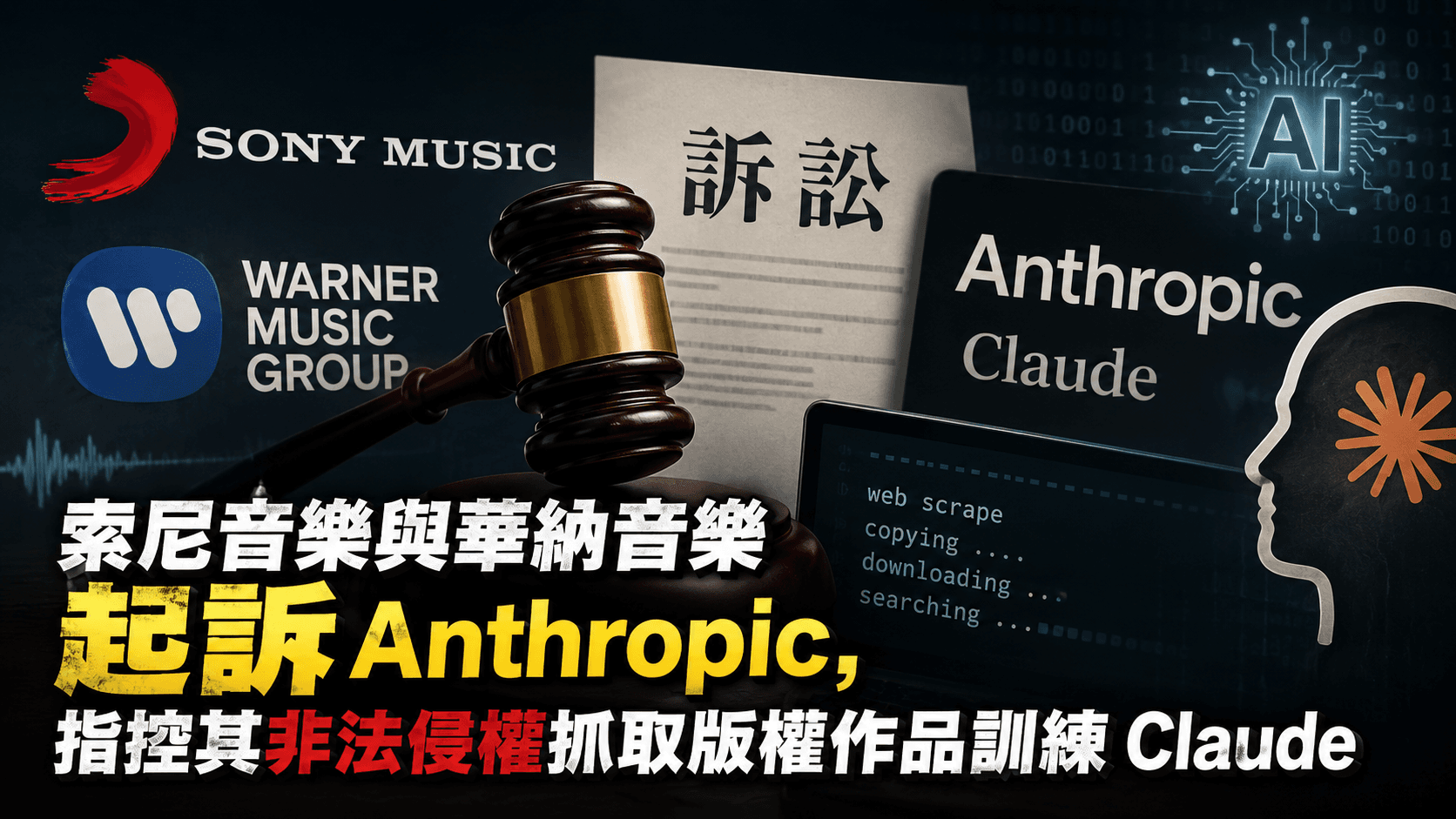
The copyright storm around generative AI (GenAI) has escalated again, with music publishing giants launching a legal offensive against a top AI lab. Leading music publishers including Sony Music Publishing and Warner Chappell formally filed a major infringement lawsuit against Anthropic and its founders in the US District Court for the Northern District of California on August 29, 2026, accusing the company of plundering copyrighted music assets on a massive scale without authorization.
The complaint accuses Anthropic of highly controversial data collection methods, alleging that it secretly obtained millions of copyrighted works, including lyrics and sheet music, through illegal torrent downloads and large-scale web crawling, and fed them all into the training data for its flagship Claude large language model. The accusation undercuts AI companies' usual defense that they only scrape public web pages, pushing the dispute directly into the sensitive territory of unauthorized P2P distribution and systematic infringement.
The lawsuit is not only a key battle between the global music industry and tech giants but also puts heavy pressure once again on Anthropic, which has just paid a huge legal price. Although the company was approved in July 2026 to pay a settlement of up to US$1.5 billion in the Bartz class action in an attempt to put copyright disputes to rest, traditional rights holders clearly have no intention of backing down. A long legal war over the legality of algorithm training and the protection of intellectual property value is now fully underway.
Key takeaways
- Sony and Warner Music sued Anthropic for infringement in California federal court on August 29, 2026.
- The complaint alleges Anthropic used illegal torrent downloads and crawlers to grab millions of lyrics and sheet music to train Claude.
- Anthropic only reached a US$1.5 billion settlement in the Bartz case in July 2026, and now faces another major copyright blow.
- An Anthropic spokesperson denied all the allegations, stressing that the company will vigorously defend its rights and the legality of its technology in court.
From web crawlers to illegal torrents: the fatal controversy over training data sources
The legality of AI training data sources is facing unprecedented scrutiny. In the past, tech giants mostly defended scraping public web pages under the fair use doctrine. But the plaintiffs in this case allege that Anthropic used P2P torrent channels to obtain copyrighted digital files, which, legally speaking, is very likely to fall outside the protection of fair use. If the plaintiffs prove at trial that Anthropic's servers contain records of unauthorized peer-to-peer file transfers, the conduct could be found to be willful, knowing direct infringement, further undermining the "transformative use" defense for generative models.
The structured data in lyrics and sheet music is key nourishment for improving large language models' reasoning and cultural understanding. To give Claude better accuracy than its rivals in text generation, rhythm alignment and emotional semantic analysis, high-quality musical and literary assets became an indispensable source of training data. But when these highly valuable intellectual property assets are turned into billions of dimensions of vector weights without permission, the real economic damage claimed by rights holders is hard to ignore. It also highlights a huge compliance blind spot in data governance at top AI labs chasing model performance.
A US$1.5 billion settlement can't stop the bleeding: an AI giant's copyright legal and business crisis
The huge settlement did not buy Anthropic a long-term legal safe harbor; instead, it may set off a chain reaction of claims from rights holders. Looking back to July 2026, Anthropic had just been approved by the court to pay a staggering US$1.5 billion to resolve the Bartz class action, one of the largest settlements in generative AI. But the settlement didn't close the matter. It sent a clear signal to content industries worldwide that copyright lawsuits against AI companies have huge commercial value and real leverage, encouraging top rights groups such as Sony Music Publishing and Warner Chappell to launch a new, more aggressive round of legal attacks.
Ongoing litigation risk is gradually eroding the commercial valuations and operating profits of the generative AI industry. Facing strong accusations from rights holders, an Anthropic spokesperson publicly pushed back and vowed to fight to the end in court. But rising legal defense costs and potential damages will seriously affect how it allocates R&D funds. More importantly, if a future ruling requires Anthropic to remove certain infringing data or retrain the core of its Claude model, the huge cloud compute cost of retraining and enterprise customers' worries about compliance risk could deal a devastating blow to its cloud API services and enterprise solutions.
Global impact as copyright is redefined: lessons for Taiwan and the Asia-Pacific digital content industry
Precedents from US and European copyright cases will reshape the licensing ecosystem for generative AI and digital content in the Asia-Pacific region. For a long time, digital content creators and music publishers in Taiwan and across Asia have been weak and passive when facing data scraping by multinational tech giants. The litigation strategy and evidence battles of Sony Music and Warner Music in US federal court will give Taiwan's cultural content industry and legal authorities a very valuable reference framework, speeding up the creation of standardized licensing for local-language data and Mandarin music assets.
Enterprise AI adoption strategies will be forced to focus on "data cleanliness" and "verifiable compliance." As international copyright disputes heat up, when Taiwanese companies evaluate Claude, GPT or other commercial large language models, compliance audit standards will expand from raw performance to tracing the origins of training data. Local software developers and system integrators who want to build internationally competitive vertical models must build transparent data cleaning, licensing records and intellectual property protections into their architecture from the ground up to stay on their feet in an increasingly strict global digital regulatory storm.
Frequently asked questions (FAQ)
What is the core dispute in Sony and Warner's lawsuit against Anthropic?
The core of the case is that Sony Music and Warner Music accuse Anthropic of obtaining millions of copyrighted lyrics and sheet music without authorization, through illegal means such as illegal torrent downloads and web scraping, and using them directly to train the Claude model, allegedly amounting to systematic and serious intellectual property infringement.
Why didn't Anthropic's earlier US$1.5 billion settlement prevent this lawsuit?
The US$1.5 billion Bartz settlement that Anthropic reached in July 2026 only covered a specific group of plaintiffs and scope of copyrights. It did not include the proprietary music assets of Sony Music Publishing and Warner Chappell, so the music publishing giants still have every legal right to file a new civil damages suit over their own damaged copyrights.
How could this case affect businesses that use Claude?
If the court ultimately finds that Anthropic infringed, the company could face enormous fines or even be forced to retrain and delete some of Claude's training weights. This could lead to changes in existing model features or terms of service, and push enterprise users to apply stricter reviews of data compliance when adopting AI software and cloud services.
The era of generative AI "profiting from data for free" is officially over, and the industry's rules are being completely rewritten. From crawler controversies to torrent lawsuits, the growth model that top AI labs relied on, expanding quickly in gray areas, is no longer sustainable. Future market competition will not only be about architecture and compute scale but also about each company's overall ability to build a legal, compliant and sustainable content licensing ecosystem. Only technology that respects the value of original intellectual property can truly hold its ground in the coming new global regulatory order.