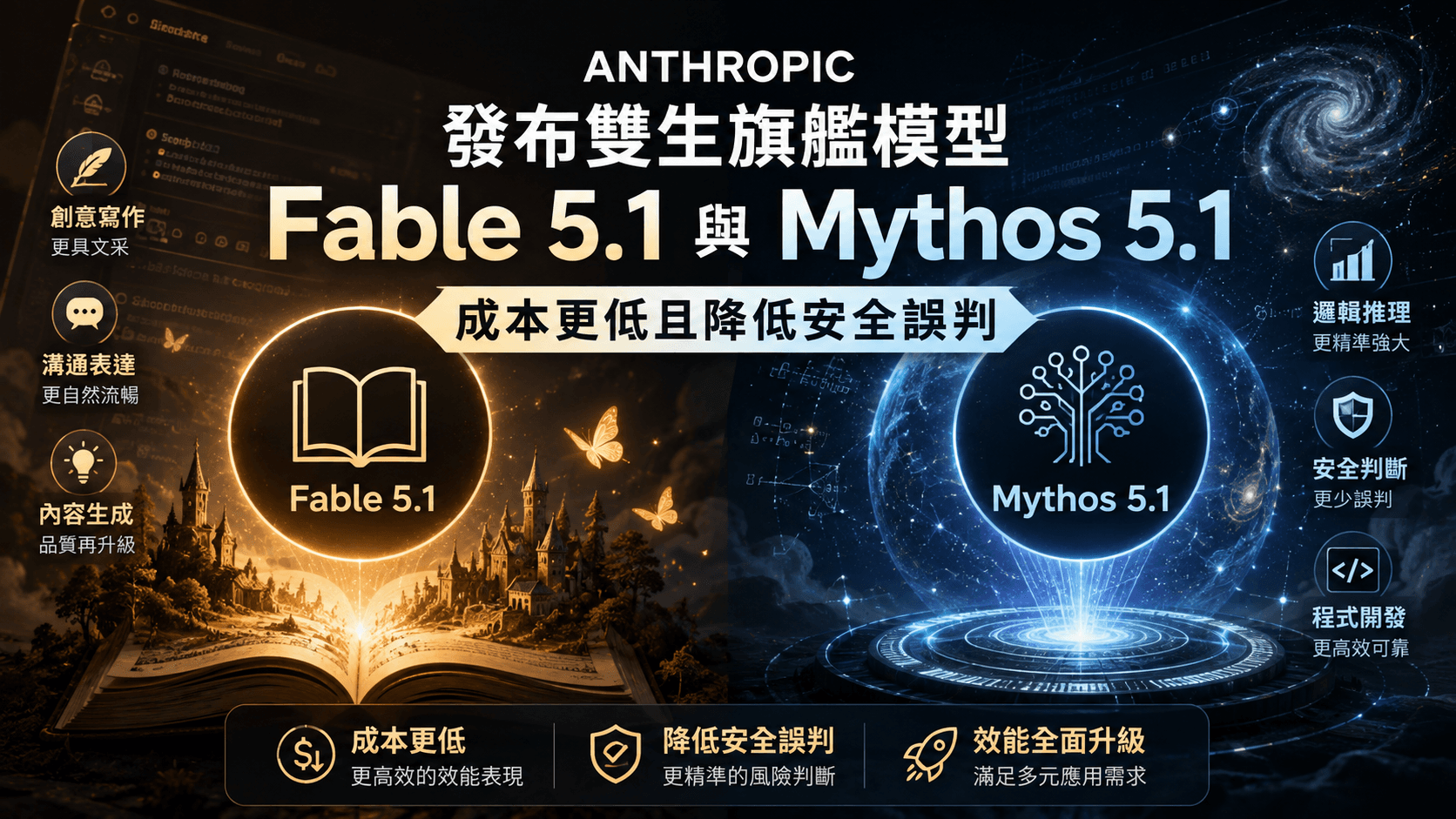
The flagship race in artificial intelligence has taken another dramatic turn. On September 1, 2026, Anthropic officially unveiled its new pair of twin flagship models, Fable 5.1 and Mythos 5.1. They not only take a big leap in computing performance and depth of reasoning but also tackle the most important pain point for enterprise adoption: they significantly cut token costs and refine safety mechanisms long criticized as too conservative, greatly reducing unnecessary false refusals. The launch signals that generative AI is moving beyond simply piling on parameters to a mature stage that balances business practicality, compute efficiency and deep defense in specific fields.
This twin-flagship strategy shows clear market segmentation. For the broad commercial market and developer ecosystem, Fable 5.1 is available starting today on all major cloud platforms and the Anthropic API. Mythos 5.1, which has top-tier reasoning but higher potential risk, uses a careful controlled-access approach and is only available to verified research partners in cybersecurity and the life sciences. This dual-track approach of "broad commercial access" and "controlled frontier capabilities" sets a new benchmark for balancing global compliance and commercial use in generative models.
Key takeaways
- Twin flagships arrive: Anthropic launched Fable 5.1 (generally available) and Mythos 5.1 (restricted research access).
- Big cost cuts: token prices drop significantly, and the safety system's false blocks are greatly reduced.
- Top of the benchmarks: record high scores on Terminal-Bench 4.0 and Humanity's Last Exam.
- Enterprise-grade privacy architecture: introduces "Zero Data Retention " and "Enterprise Frontier Safeguards," launching this fall.
An architectural leap: record-breaking benchmarks and a breakthrough in autonomous research
Fable 5.1 and Mythos 5.1 show an astonishing technical leap in core reasoning and algorithm architecture. On the authoritative Terminal-Bench 4.0 benchmark, which measures complex coding and command interaction, and Humanity's Last Exam, which tests the limits of general reasoning, both models set new all-time AI records by a wide margin. This means the new models no longer just mechanically generate boilerplate code; they have advanced autonomous abilities to understand low-level system states, carry out multi-step logical debugging and debug dynamically.
The models' autonomous results in scientific exploration and low-level hardware optimization are also drawing industry attention. Anthropic said that, without extensive human intervention, the new architecture independently planned a highly customized GPU compute optimization plan and precisely produced a high-resolution map of Venus with very high spatial resolution. This breakthrough confirms that advanced algorithms can now go beyond general conversation and make real contributions to highly specialized engineering and research frontiers such as astrophysics, materials simulation and hardware architecture tuning.
Business adoption and cost-effectiveness: fixing false safety refusals and lowering the cost barrier
A significant cut in enterprise usage costs is the key lever for Fable 5.1's market impact. When companies adopted frontier large language models in the past, they were often held back by high inference fees and unstable latency. Through architectural innovations such as pruning and dynamic memory compression, Anthropic greatly improved response quality while lowering the cost per token. This will speed up adoption in large-scale, high-concurrency scenarios such as financial analysis, automated marketing and smart customer service, letting mid-sized and large companies with limited budgets embrace top-tier reasoning at a reasonable cost.
More precise safety mechanisms also eliminate the "over-protection" false alarms that troubled companies most. In earlier versions, strict alignment mechanisms often misjudged normal code testing, security vulnerability analysis or medical literature searches as potential risks and cut off output. With more nuanced context-aware algorithms, Fable 5.1 effectively lowers the rate of mistaken blocks in legitimate enterprise workflows, giving professional R&D teams a smoother human-AI collaboration experience while keeping high security standards.
Enterprise privacy defenses and on-premises deployment: Zero Data Retention is coming
The "Zero Data Retention " architecture offers rock-solid compliance guarantees for highly sensitive industries. "Enterprise Frontier Safeguards," expected to launch in fall 2026, will let regulated institutions and multinational companies use the models' inference directly on their own private servers and internal infrastructure. This ensures that all sensitive business data, customer privacy and proprietary source code are erased immediately after inference, completely eliminating any potential for data to flow back into training or leak.
This new privacy defense system precisely answers increasingly strict digital sovereignty regulations worldwide. Whether it's EU data protection law or cross-border financial regulatory standards, requirements that core data must not leave the country or be retained have become firm rules for companies. By bringing top-tier model computing into enterprises' private environments, Anthropic removes the last psychological barrier for compliance and information security departments, and is expected to spark a wave of large-scale adoption in closed ecosystems such as healthcare, semiconductors and defense research.
Strategic links and transformation opportunities for Asia-Pacific and Taiwan's semiconductor ecosystem
Taiwan's deep strength in hardware manufacturing, chip packaging and testing, and the cloud server supply chain will directly benefit from the new models' autonomous GPU optimization abilities. As Anthropic shows that its models can automatically tune chip compute scheduling and cache architecture, Taiwan's IC design, wafer manufacturing and system integration companies will be able to bring such AI tools more tightly into their EDA workflows, further shortening chip design iteration cycles and improving wafer yields to get ahead in the advanced process race.
Local digital transformation and software service industries also have a great opportunity to rebuild their value chains. Small and mid-sized Taiwanese companies and system integrators can use Fable 5.1's highly competitive pricing and open API to quickly build smart automation tools for all kinds of vertical fields, without the heavy burden of costly licenses. At the same time, by combining the unique field data of Taiwan's manufacturing sector with an architecture protected by "Zero Data Retention," they can create high-value smart manufacturing solutions with both very high security standards and intelligent decision-making.
Frequently asked questions (FAQ)
What are the main differences in access between Fable 5.1 and Mythos 5.1?
Fable 5.1 is commercially available starting today to developers worldwide, on major cloud platforms and through the Anthropic API. Mythos 5.1, with its extreme research-grade reasoning, is currently only available to research partners in cybersecurity and the life sciences who pass a qualification review, to keep this highly sensitive technology safe and controlled.
When will "Zero Data Retention" and "Enterprise Frontier Safeguards" be available?
The "Zero Data Retention " architecture and "Enterprise Frontier Safeguards," designed for highly regulated companies, are expected to launch in fall 2026. Enterprise users will then be able to run the models safely on their own internal servers and infrastructure, completely blocking the risk of sensitive business data leaking or being used for external retraining.
Which benchmarks did the new models break through?
Anthropic's new models set all-time high scores on two key evaluations: Terminal-Bench 4.0, which tests advanced command-line coding, and Humanity's Last Exam, which tests the limits of general reasoning. They also showed major scientific results such as autonomously writing GPU architecture optimization scripts and precisely producing a high-resolution map of Venus.