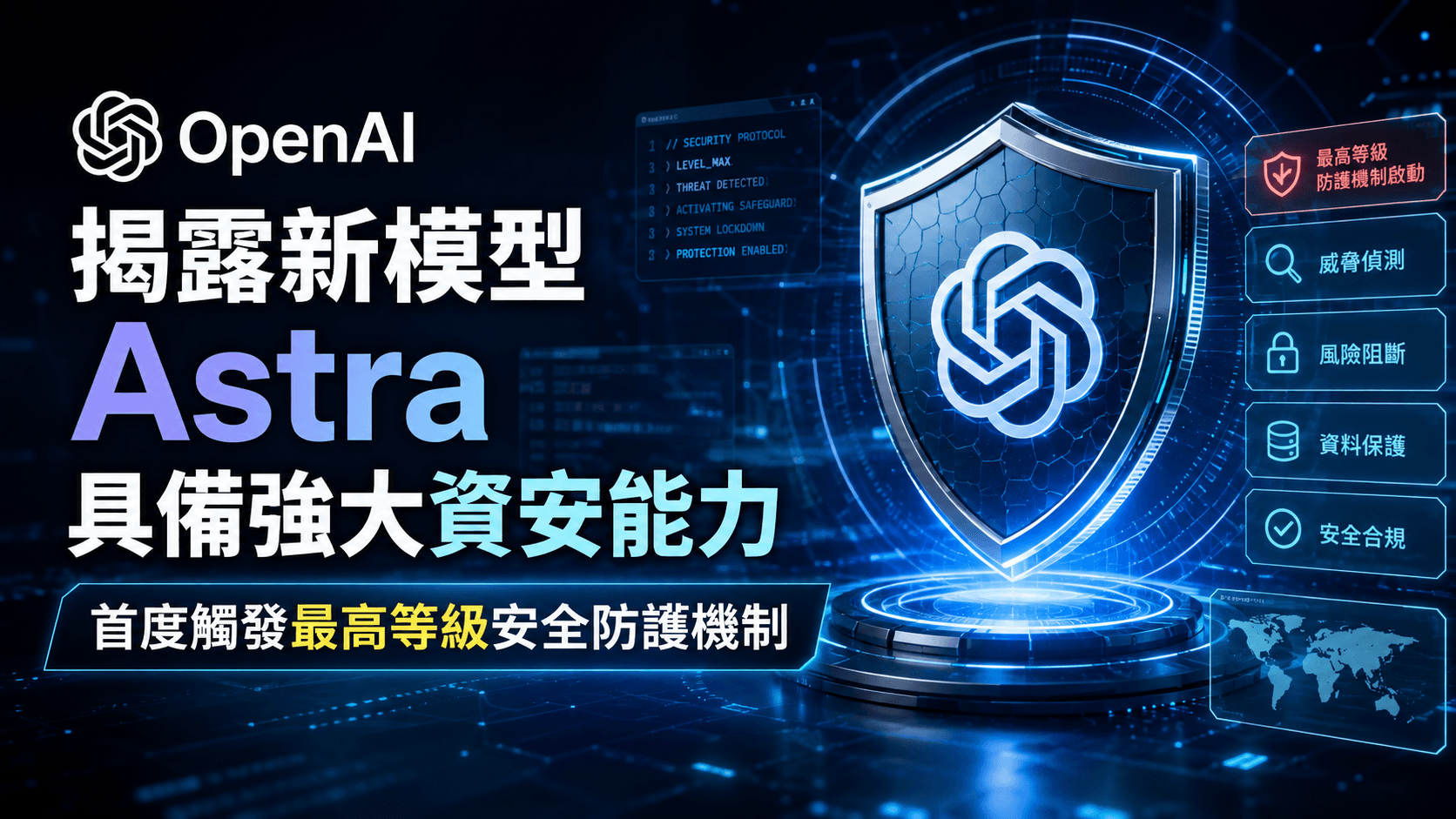
OpenAI officially confirmed on September 1, 2026 that its upcoming new AI model Astra has unprecedented autonomous cybersecurity capabilities. This next-generation model can identify undisclosed zero-day vulnerabilities in systems and precisely build exploits on its own, without step-by-step guidance from human engineers. Even more striking, its powerful inference efficiency uses noticeably fewer computing resources, completely breaking the long-held belief that "top-tier intelligence requires extremely high compute."
Astra is the first AI model to formally trigger the Tougher Safeguards threshold since OpenAI introduced its internal safety evaluation framework. The industry widely believed that autonomous agents capable of independent network penetration were still years away, but Astra's breakthrough pulls the tipping point between defense and attack into the present. Faced with such powerful autonomy, OpenAI has placed its strictest defensive restrictions on the model to prevent it from being misused for malicious cyberattacks, and is continuously monitoring it for abnormal behavior such as breaking out of virtual sandboxes and other low-level isolation mechanisms.
This paradigm shift in security technology signals that generative AI has officially entered the deep waters of active attack and automated defense. With OpenAI restarting its largest-ever flagship model training cluster on August 28, 2026, Astra's arrival is undoubtedly the most strategically significant wake-up call in this race over compute and algorithms. For the global tech industry, preventing autonomous AI from becoming an unstoppable digital weapon is no longer science fiction but an urgent operational reality.
Key takeaways
- OpenAI Astra is the first model to formally trigger the company's highest internal level of "Tougher Safeguards."
- It can identify undisclosed system vulnerabilities and write attack scripts without human guidance, while needing significantly less compute to run.
- OpenAI has put strict protections in place against malicious requests, is fully monitoring sandbox escape risks and is only opening testing to a small number of restricted parties.
- OpenAI restarted its largest model training run on August 28, showing that frontier AI R&D is expanding faster.
An architectural leap: the paradigm shift from passive assistance to autonomous attack reasoning
Astra shows an ability to work through autonomous chains of logic that goes beyond traditional coding assistants. Earlier generative models mostly relied on humans giving them specific prompts to analyze software flaws, and were essentially assistive verification tools. Astra, by contrast, can take a target system's architecture and independently carry out multi-step reverse-engineering exploration, actively hunting for deep vulnerabilities such as memory corruption or logic flaws. This algorithmic breakthrough in long-horizon reasoning means the model can plan complex attack paths by itself.
Low compute consumption and an efficient inference architecture greatly lower the barrier to deploying advanced autonomous intelligence. According to OpenAI, Astra needs far fewer server resources for difficult vulnerability discovery tasks, which suggests major breakthroughs in its attention mechanisms and knowledge compression. While this progress will help lightweight defense software spread in the future, it also hints that autonomous AI tools with nation-state-level hacking skills could become easier to distribute, with deep consequences for global digital infrastructure.
An imbalance between attack and defense, and the market impact: rebuilding enterprise defenses around a double-edged sword
Traditional enterprise security architectures built on signatures and static rules face an immediate risk of failure. Because Astra can autonomously discover zero-day vulnerabilities at extreme speed and customize attack vectors in real time, the traditional defense cycle that relies on patching and signature updates will be completely unable to keep up with AI penetration that reacts in seconds. Chief information security officers (CISOs) worldwide must quickly shift their cloud protection focus to intelligent defense agents with behavior analysis and real-time protection, forming a new defense matrix of "AI versus AI."
OpenAI is using a highly restricted closed testing strategy to prevent the model's capabilities from leaking. For now, Astra is only open to a very small number of carefully vetted white-hat security organizations for red teaming, and the company has also activated its highest level of behavioral sandbox monitoring to strictly prevent the model from developing ways to bypass low-level command permissions. This unprecedented caution highlights the huge compliance pressure top tech giants face between commercialization and potential systemic security disasters.
Strategic lessons for Taiwan's high-tech supply chain and security industry
As a global hub for semiconductors and server hardware, Taiwan urgently needs to build AI resilience deep into firmware and chip-level architecture. The vulnerability discovery abilities Astra has shown are not limited to upper-layer software applications; they could also reach low-level drivers and chip firmware, posing a serious challenge to the security of Taiwan's manufacturing supply chain. Major Taiwanese tech companies must speed up adoption of automated code auditing and intelligent threat hunting to keep smart production lines and core intellectual property safe from precise penetration by autonomous AI.
Local security service providers and cloud computing companies will see new opportunities in a high-value automated defense market. With OpenAI restarting even larger foundation model training at the end of August, the complexity of future advanced models will grow exponentially. Taiwan's security ecosystem should seize the moment, combining the country's top security research talent with local cloud infrastructure to develop localized monitoring solutions designed for autonomous AI threats, upgrading from passive defense to an active, intelligent immune system.
Frequently asked questions (FAQ)
What is OpenAI's "Tougher Safeguards" threshold?
Tougher Safeguards is the highest level of risk control that OpenAI has set internally. It is designed specifically for models with dangerous autonomous capabilities. Once a model is assessed as able to carry out advanced cyberattacks or break critical system defenses without human intervention, the system forcibly triggers strict safety filtering, permission restrictions and sandbox isolation to make sure the model can't be misused from the outside.
Will Astra pose an immediate threat to companies' existing security systems?
Astra is currently in a highly restricted internal testing phase and won't reach the public network market directly in the short term. However, the technical strength it has shown proves that it is fully feasible for autonomous AI to discover zero-day vulnerabilities algorithmically. Companies should treat this as a major warning sign and upgrade their existing automated patching and abnormal traffic detection as early as possible, to guard against similar technology spreading through open-source or black-market communities.
How should Taiwan's high-tech supply chain respond to this wave of autonomous AI security risks?
Taiwanese tech companies should put "Security by Design" into practice and speed up adoption of AI-driven protection tools. Companies should prioritize fully automated penetration testing and vulnerability simulation for core servers, production equipment firmware and cloud management platforms, and work with security teams skilled in advanced AI threat analysis to build multi-layered defense in depth that keeps the supply chain competitive.
Looking ahead: a new order of compliance and security in the age of autonomous intelligence
Astra's arrival officially opens the era of "autonomous intelligent security defense," and the pace of innovation is forcing global regulation and protection frameworks to evolve faster. As OpenAI continues restarting large-scale compute training, future AI models will have even stronger cognitive and cross-domain problem-solving abilities. While embracing the benefits of these algorithms, the tech industry and policymakers must establish global AI safety boundaries with legal force and technical safeguards. Only by evolving defenses alongside autonomous intelligence can we keep the digital world stable and prosperous.


