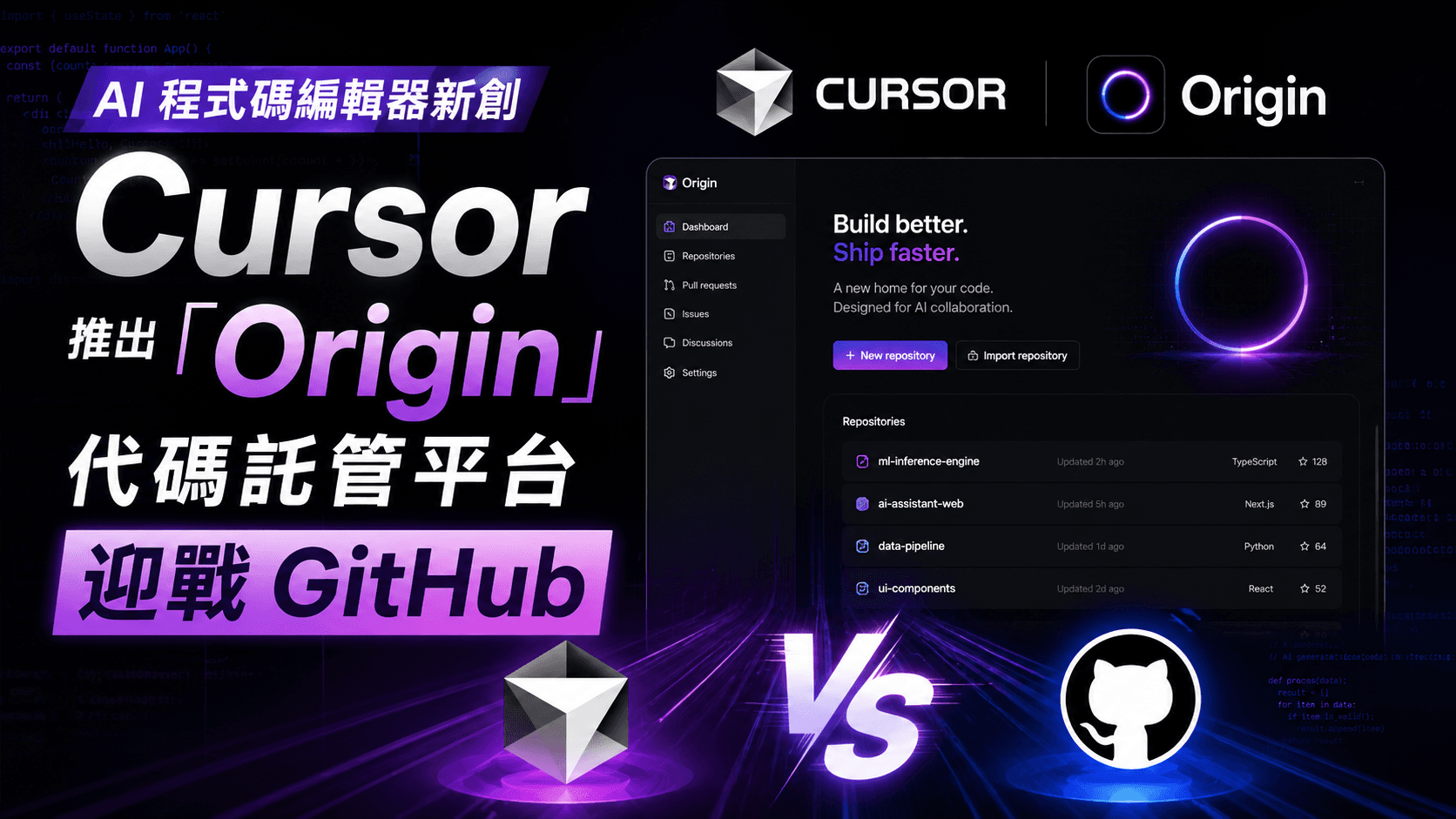
The global software engineering world has been hit by a bombshell. Cursor, the leading AI code editor brand, officially unveiled a new code hosting platform codenamed "Origin" on August 18, 2026. This major move marks Cursor, now part of SpaceX, officially expanding from developer tools into core cloud infrastructure, directly declaring war on GitHub, which Microsoft has long dominated. It's not just a new round of competition in the code repository market but a paradigm shift in software development workflows from "human collaboration" to "collaboration with autonomous AI agents."
Ironically, on the day Origin launched, GitHub happened to suffer a massive global outage lasting more than 6 hours, with its error rate soaring close to 20% at one point. This server disaster was the perfect assist for Cursor, highlighting the developer community's long-standing worries about the stability and modernity of traditional code hosting platforms.
Taking on GitHub's dominance head-on: Cursor launches the new code hosting platform "Origin" and an agent-native ecosystem
Key takeaways
- Cursor launched the new code hosting platform Origin, directly challenging Microsoft's GitHub.
- The platform supports two-way sync, team collaboration, PR reviews and "agent-native" autonomous agent features.
- GitHub suffered an outage of more than 6 hours on launch day and has had 257 outages in the past year.
Two-way sync lowers the migration barrier: Origin's technical foundation and architectural breakthrough
The Origin code hosting platform shows great engineering wisdom in its architecture, completely breaking down the technical barriers of traditional repository migration. The Cursor team knows how much developers rely on existing workflows, so Origin natively offers full team collaboration, version control, online Pull Request (PR) reviews and a high-performance browser editing environment, along with built-in real-time two-way sync with GitHub. This means companies don't have to risk downtime moving existing projects all at once. Team members can work across both platforms in parallel without changing existing CI/CD pipelines, greatly reducing the friction of trying and adopting a new system.
Unlike the legacy baggage of traditional Git-centric platforms that gradually piled on plugins, Origin is optimized from the ground up with a modern distributed cloud architecture. For searching and indexing large codebases, the system uses vector storage and real-time streaming algorithms optimized for neural network search, bringing code search and semantic understanding latency down to milliseconds. This architectural advantage lets developers enjoy smooth code navigation and tracing even on very large projects with millions of lines of code, laying a solid foundation for deeper automation in the future.
Stability worries boil over: a chance to reshape the market amid frequent GitHub outages
Concerns about the stability of GitHub's infrastructure have become an operational risk global tech companies can't ignore. In the past year, Microsoft's GitHub has had as many as 257 service outages. Frequent degraded performance and downtime have not only disrupted global engineering teams' release schedules but also caused real economic losses for multinational companies. During the 6-hour large-scale failure on August 18, nearly 20% of requests failed outright, and this crisis directly intensified the engineering world's urgent need for a "next-generation backup option."
Cursor's decision to enter the market at this critical moment isn't just luck but a precise strike at a market pain point. Drawing on parent company SpaceX's strong experience with distributed computing and high-availability infrastructure, Origin shows greater fault tolerance and resilience. As the developer community's reliance on a single platform wavers, Cursor offers the double incentive of painless sync and top-tier stability, turning market dissatisfaction into real adoption momentum for the new platform and accelerating diversity in the software hosting ecosystem.
From assistant tool to agent native: redefining the modern software development workflow
The "agent native" architecture is Origin's most disruptive core weapon, signaling that software engineering is about to enter the era of fully autonomous agents. Traditional code hosting platforms are essentially static repositories designed for human engineers, where AI can only act as a copilot offering passive code suggestions. Origin, however, treats autonomous agents as first-class citizens. In Origin's ecosystem, AI agents can independently pick up issues, develop features in isolated cloud sandboxes, run tests, submit PRs and automatically iterate on fixes based on code review feedback.
This end-to-end intelligent automation will completely reshape the role of software engineers. Developers no longer need to spend lots of time writing tedious boilerplate or doing routine debugging. Instead, they become "system architects" and "AI agent commanders." By deeply connecting the editor (Cursor Editor) with hosting (Origin Hosting), Cursor has built a closed-loop intelligent development network where code generation, review, hosting and deployment all flow quickly within a single environment that understands semantics.
Strategic implications and transformation opportunities for Taiwan and Asia's tech industry
Taiwan's high-tech hardware and software ecosystem must pay close attention to the development paradigm shift Origin is sparking. Taiwan is at a critical crossroads of digital transformation in manufacturing and software self-sufficiency. Many local companies adopting AI-assisted development face fragmented toolchains and cloud security compliance challenges. Origin's two-way sync lets Taiwanese R&D teams gradually introduce autonomous AI agent workflows without breaking existing security rules or their GitHub hosting setup, so they can measure gains in engineering performance while keeping technical risk under control.
Facing a global shortage of software talent, companies that master agent-native platforms will gain an asymmetric competitive edge in R&D delivery speed. If Taiwan's startups and mid-to-large software companies are among the first to integrate this kind of next-generation code hosting architecture with self-healing and fully automated PRs, they can achieve project iteration several times faster than before with lean R&D teams, taking the lead in the Asia-Pacific and even global digital economy.
Frequently asked questions (FAQ)
How does Cursor Origin handle compatibility with existing GitHub projects?
Origin natively supports real-time two-way code sync with GitHub. Development teams can start collaborating on Origin right away while keeping their existing GitHub repositories and CI/CD deployment processes unchanged. All commits and PRs on Origin sync seamlessly back to GitHub, completely eliminating the tedious and risky process of migrating historical code.
What is the fundamental difference between an "agent native" platform and a traditional code hosting platform?
An agent-native architecture treats autonomous AI agents as fellow developers with full operating permissions. Unlike traditional platforms that only offer static code storage and assistive suggestions, Origin lets AI agents independently read issues in the cloud, write and test code, submit pull requests and automatically complete fixes after receiving review feedback, enabling fully automated software lifecycle management.
Do companies need to fully migrate their codebases from GitHub to Origin right now?
At this stage, companies don't need an aggressive one-time migration. A gradual, dual-track evaluation strategy is recommended. Companies can first connect some non-core projects or new agile development modules to Origin's two-way sync to experience the benefits of high availability and AI agent automation, then assess wider adoption once team workflows and internal compliance processes have matured.
Cursor Origin's arrival isn't just a direct challenge to Microsoft's dominance of code hosting but also an important milestone in the history of software development. When robust cloud architecture meets deep autonomous AI agent capabilities, the traditional software engineering model built on manual input is quickly falling apart. In the coming years, the key to winning the code hosting market will no longer be just storage and version control but who can give AI agents the smoothest, smartest and never-down execution environment. This transformation, which will decide the future of software productivity, has only just begun.