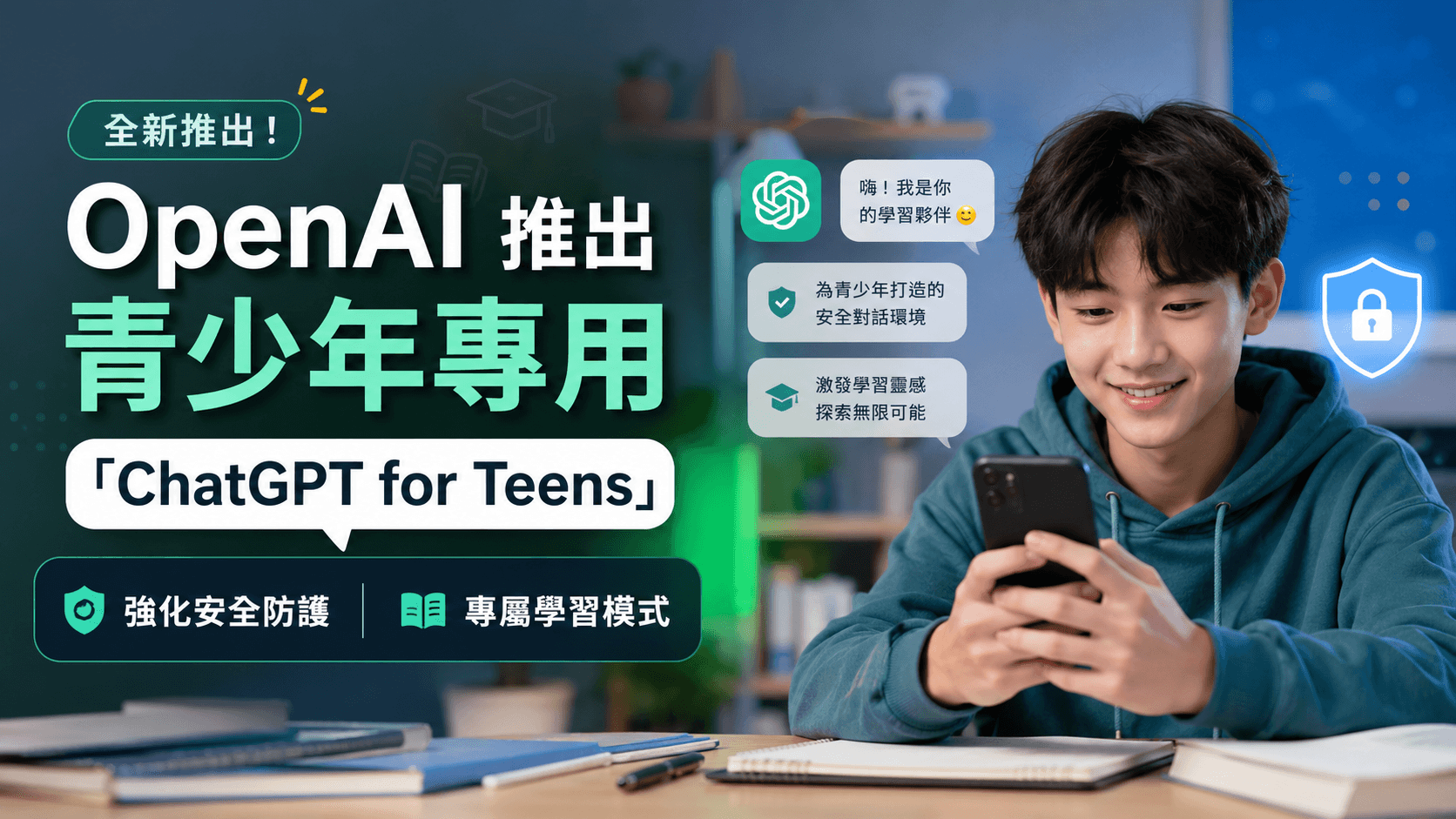
As generative AI spreads into schools and family life worldwide at astonishing speed, tech giants are finally no longer treating teenagers as just an add-on to regular users. At the key milestone of more than 900 million weekly active users (WAU) worldwide, OpenAI officially launched "ChatGPT for Teens," built specifically for teenagers, on August 18, 2026. This major product update not only fills a long-standing gap in digital safety for minors but also signals generative AI's move from a simple "productivity tool" to a "smart coach" designed with teaching and guidance in mind.
For years, educators and parents have been deeply anxious about students relying too heavily on AI, leading to "AI-written homework" and "cognitive laziness," and some education authorities in several countries even banned it on campus. The launch of ChatGPT for Teens is OpenAI's positive response to this years-long crisis of trust in education. With newly designed algorithms and interaction safeguards, the product tries to strike a precise balance between encouraging digital exploration and protecting the essence of learning, setting a compliant and inspiring standard for AI interaction for young people around the world.
Key takeaways
- OpenAI officially launched ChatGPT for Teens for teenagers on August 18, 2026, strengthening safety protections.
- A new built-in "Study Mode" and homework reminders use Socratic guiding questions to prevent direct copying.
- Age-appropriate content filtering is on by default, along with a parental control panel, quiet hours to prevent overuse and interactive quizzes.
- It partners with CodeAI to promote AI literacy education and integrates seamlessly with the "ChatGPT for Teachers" school plan.
Breaking down "Study Mode": from handing out answers to guiding critical thinking
The core design philosophy of Study Mode is to completely overturn the old habit of "generating an answer with one click." When teenagers enter a math problem, a history essay or a request to debug code, the system's backend algorithm no longer spits out a complete answer but switches to a step-by-step guided conversation. ChatGPT for Teens breaks down the core of the problem, asks guiding reflective questions and even asks students to explain their own approach first, helping users build a complete chain of logical reasoning through active thinking.
Beyond preventing cheating, the built-in homework reminders and interactive quiz tools hand control back to the learner. The smart system can detect a user's knowledge gaps from the conversation and generate custom concept-check questions at specific stages of learning, helping students review in real time in front of the screen. Computed in real time on cloud servers, this interactive approach turns AI from a "cheating machine" that dulls thinking into a personal digital tutor that can give feedback anytime.
Parental controls and safety boundaries: platform governance that balances privacy and preventing overuse
The introduction of a parental control panel and quiet hours shows that, after passing 900 million weekly active users, OpenAI is taking on more rigorous platform responsibility for minors' digital well-being. Parents can use simple settings to set bedtime or focus hours and restrict chat at night, effectively preventing teens from being so hooked on the internet that it disrupts their normal routines. This safeguard respects teenagers' freedom to explore while giving guardians reasonable information transparency and management tools.
On the content safety side, the system turns on high-standard age-appropriate filtering by default. Through an enhanced semantic safety model, the platform can proactively block sensitive content harmful to physical and mental health, violence, self-harm and inappropriate commercial marketing, and it immediately starts safety guidance when it detects signs of a potential mental health crisis. This safety framework shows OpenAI's forward-looking compliance strategy and corporate self-discipline as global rules on children's digital privacy grow stricter.
Deepening the education ecosystem: key lessons for Taiwan's classrooms and EdTech industry
OpenAI is working with CodeAI to promote AI literacy education and closely connecting it with the existing "ChatGPT for Teachers" plan, building a complete closed-loop education ecosystem. The partnership isn't only about spreading software tools but also about building students' critical thinking from a young age about algorithmic bias, telling true data from false and ethical boundaries. By empowering teachers to make good use of structured materials in class, schools can turn AI into a lever for better teaching instead of treating it as a threat.
For the Taiwanese education market, which is actively pushing "a tablet for every student" and deeper digital teaching, ChatGPT for Teens offers a highly valuable model for transformation. Local EdTech software companies and educational institutions in Taiwan should pay close attention to smart interactive architectures with "guided learning mechanisms" like this and think about how to combine local curriculum materials and a Traditional Chinese context to build localized solutions that balance learning results with safety.
Frequently asked questions (FAQ)
What is the core difference between ChatGPT for Teens' "Study Mode" and the standard version?
Standard ChatGPT tends to give comprehensive, direct answers quickly, while ChatGPT for Teens ' "Study Mode" uses guiding questions and step-by-step breakdowns to lead students to think for themselves and reach conclusions on their own, with interactive quizzes to reinforce memory, fundamentally keeping students from copying and pasting content as homework.
Can parents see all of their teen's conversations through the control panel?
The system is designed to balance privacy and supervision. The parental control panel mainly offers usage time limits (such as quiet hours), safety level adjustments and a high-level analysis of learning topics. It doesn't provide complete real-time monitoring of conversations, aiming to protect teens' space for independent thinking while maintaining a basic safety net.
How should Taiwan's schools and teachers respond as this teen-only tool spreads?
Taiwan's classrooms should actively combine the tool with the "ChatGPT for Teachers" plan, shifting the focus from "stopping students from using AI" to "designing guided assignments that require higher-order thinking and critical review," leading students to make good use of AI's questioning abilities and deepen independent inquiry and digital literacy.
The launch of ChatGPT for Teens isn't just another product variation but an important milestone in generative AI's journey to mature integration into society. As the tech industry begins shifting from chasing the fastest answers to deepening human thinking, this safety framework built for the next generation is sure to redefine how humans and machines work together over the next decade, setting a more responsible and healthy benchmark for digital learning environments worldwide.