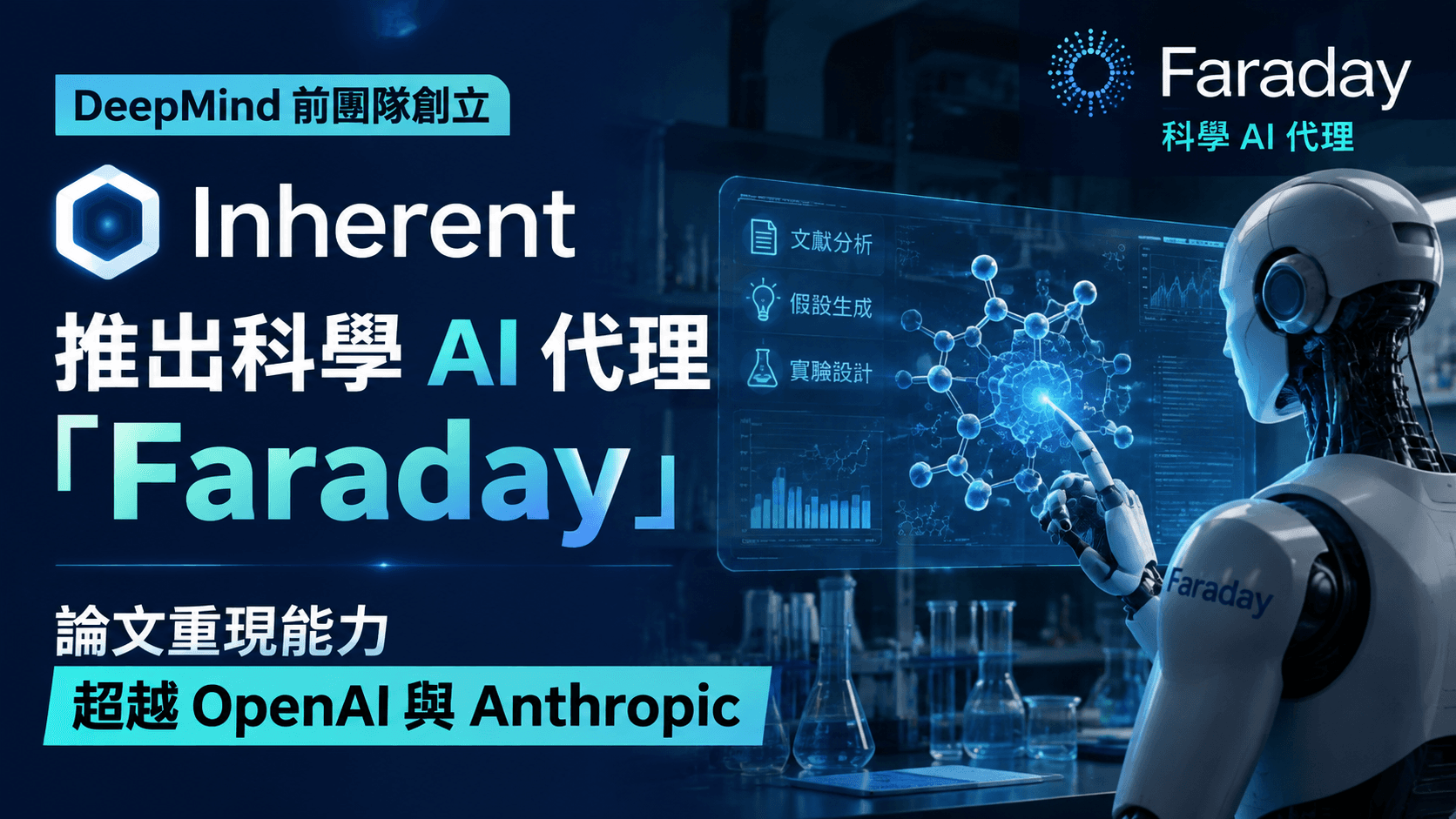
The reproducibility crisis in scientific research has plagued academia for years, but Inherent, an AI lab founded in London by a former Google DeepMind team, is trying to end this nightmare with a new algorithmic paradigm. The team officially launched "Faraday," an AI agent built specifically for scientific discovery. In blind tests with no reference answers provided, it independently reproduced the experimental data and conclusions of published top-tier papers, with accuracy surpassing industry giants OpenAI GPT-5.5 and Anthropic Claude Opus 4.8.
The most striking part of this breakthrough is that Faraday doesn't rely on brute-force computing from hundreds of billions of parameters. It is built on the open-source base model Qwen 3.6 with just 27 billion (27B) parameters. Using an innovative reinforcement learning framework, the Inherent team gave the AI the kind of "research taste " once considered unique to top scholars, letting the model independently identify high-value hypotheses and plan complex experimental paths.
Backed by US$50 million in seed funding, Inherent has taken a highly pragmatic approach to system architecture. It hands code writing and terminal execution to OpenAI GPT-5.5 Codex, letting Faraday focus all its compute on high-level scientific logic checks and research design, setting a new benchmark for research automation worldwide.
Key takeaways
- Inherent launched the research AI agent Faraday, whose paper reproduction beats GPT-5.5 and Claude Opus 4.8.
- Its core uses only the 27B open-source model Qwen 3.6, with reinforcement learning giving the model crucial "research taste."
- A division-of-labor architecture calls GPT-5.5 Codex to run code while Faraday focuses on architecture and logical reasoning.
- It has closed a US$50 million seed round, with the goal of building a digital collaborator that explores unknown scientific territory on its own.
Inside the architecture: how does a small model use "research taste" to beat giant closed-source LLMs?
A specialized agent architecture and high-level cognitive training are the decisive reasons Faraday can beat models dozens of times its size with only 27B parameters. When faced with cutting-edge scientific literature, general-purpose large language models often fall into a trap of hallucinations: "fluent text with no real scientific logic." The Inherent team skipped the arms race of blindly scaling parameters (the scaling law) and instead focused on precise guidance from reinforcement learning algorithms, using reward mechanisms to shape the model's scientific critical thinking and hypothesis evaluation, teaching the AI to weigh experimental resources and the value of arguments like a senior scientist.
A modular, decoupled design greatly improves the efficiency and fault tolerance of scientific discovery tasks. In Faraday's workflow, scientific thinking and code execution are clearly separated. The base Qwen 3.6 model focuses on analyzing abstract concepts, planning experimental design and closing logical loops, while the actual code writing, server environment setup and script execution are handed off seamlessly to GPT-5.5 Codex from Microsoft and OpenAI. This "the brain makes decisions, specialized tools execute" engineering design removes the attention drift a single model suffers on long, complex tasks, achieving very high accuracy in reproducing paper data.
A qualitative shift in the research market: from "literature summary assistant" to "autonomous experiment collaborator"
The research automation industry is undergoing a paradigm shift from passive retrieval to active reasoning, and Inherent's breakthrough is a core driver of this wave. In recent years, AI tools adopted in biopharma and materials science have mostly been limited to extracting paper summaries, mapping literature connections or querying basic databases, unable to truly take part in the core process of developing hypotheses. Faraday's arrival proves AI can, without hints about prior results, independently sort out research context, work backward to experimental parameters and complete verification. This will greatly shorten the literature verification phase of early drug development, which can last years.
The strong injection of US$50 million in seed funding reflects top venture capital firms' strong confidence in the commercial potential of AI agents built for science. As global corporate R&D spending rises and the shortage of top research talent worsens, AI collaborators capable of independent verification will become indispensable digital assets for research institutions and multinational companies. Inherent is not only challenging the commercial dominance of general-purpose large models but also providing a clear and highly convincing blueprint for the open-source ecosystem to succeed commercially in high-value vertical fields.
Strategic lessons for Taiwan's high-tech industry: a path forward for semiconductor materials and biomedical R&D
Taiwan's semiconductor process optimization and advanced packaging R&D can learn a lot from Faraday's architecture. Taiwan's tech industry has built up huge but highly fragmented experimental literature and process data in cutting-edge fields such as advanced process materials and compound semiconductor wafer growth. Bringing in specialized AI agents with "research taste" to automatically verify and reproduce formulas from the latest global patents and journals would significantly lower R&D teams' trial-and-error costs and help Taiwan stay ahead in the race for nanoscale processes.
Local biotech, pharmaceutical and smart healthcare ecosystems should move even faster to adopt an R&D model that pairs an open-source base with specialized reinforcement learning. Rather than relying on expensive, black-box closed cloud models from overseas, Taiwan's industry, academia and research institutes can perform domain alignment and agent architecture fine-tuning on open-source models using Traditional Chinese and local clinical data. This research agent model, which combines data privacy protection, cost-effectiveness and high accuracy, will be a key advantage for Taiwan to stand out in the global wave of smart healthcare and precision biotech.
Frequently asked questions (FAQ)
Faraday uses only the 27B Qwen 3.6 model. Why can it beat GPT-5.5 and Claude Opus 4.8 at reproducing scientific papers?
Specialized reinforcement learning algorithms and a decoupled architecture are the main reasons Faraday wins. The Inherent team didn't blindly chase model size. It used reinforcement learning to give the model "research taste " for judging scientific value and handed the heavy code writing to GPT-5.5 Codex, so the 27B base can focus fully on high-level scientific reasoning and experimental design, avoiding the hallucinations general-purpose large models suffer in deep chains of logic.
What specific ability does "research taste" represent in an AI science agent?
"Research taste " means the AI has the critical decision-making ability to proactively select high-potential hypotheses, spot experimental flaws and sensibly plan verification paths. The agent is no longer just a tool that passively follows instructions. Like a senior scholar facing complex, unknown literature and changing conditions, it can judge for itself which scientific paths are most worth reproducing and have the most breakthrough potential.
What is the biggest benefit for companies and academic institutions adopting specialized research AI agents like Faraday?
Greatly shortening R&D trial-and-error cycles and removing barriers to research reproducibility are the core value of adopting a specialized research agent. Companies can automatically reproduce and test the latest patents and papers published worldwide within hours, greatly reducing the cost of early research in fields like new drug development and new materials synthesis, so R&D teams can focus on the breakthroughs with the most commercial and academic value.
Industry outlook: a new era of accelerated automated scientific discovery
Autonomous research AI agents will completely reshape the pace of global scientific innovation within the next five years. With Inherent and Faraday establishing a new paradigm of small beating big, future scientific competition will no longer depend only on who has the largest compute center but on who can build the algorithmic thinking framework with the best research taste and the most efficient collaboration. Human scientists will be freed from heavy, repetitive literature review work and instead steer research direction at a higher level, working with AI to open a golden age of knowledge discovery like never before.