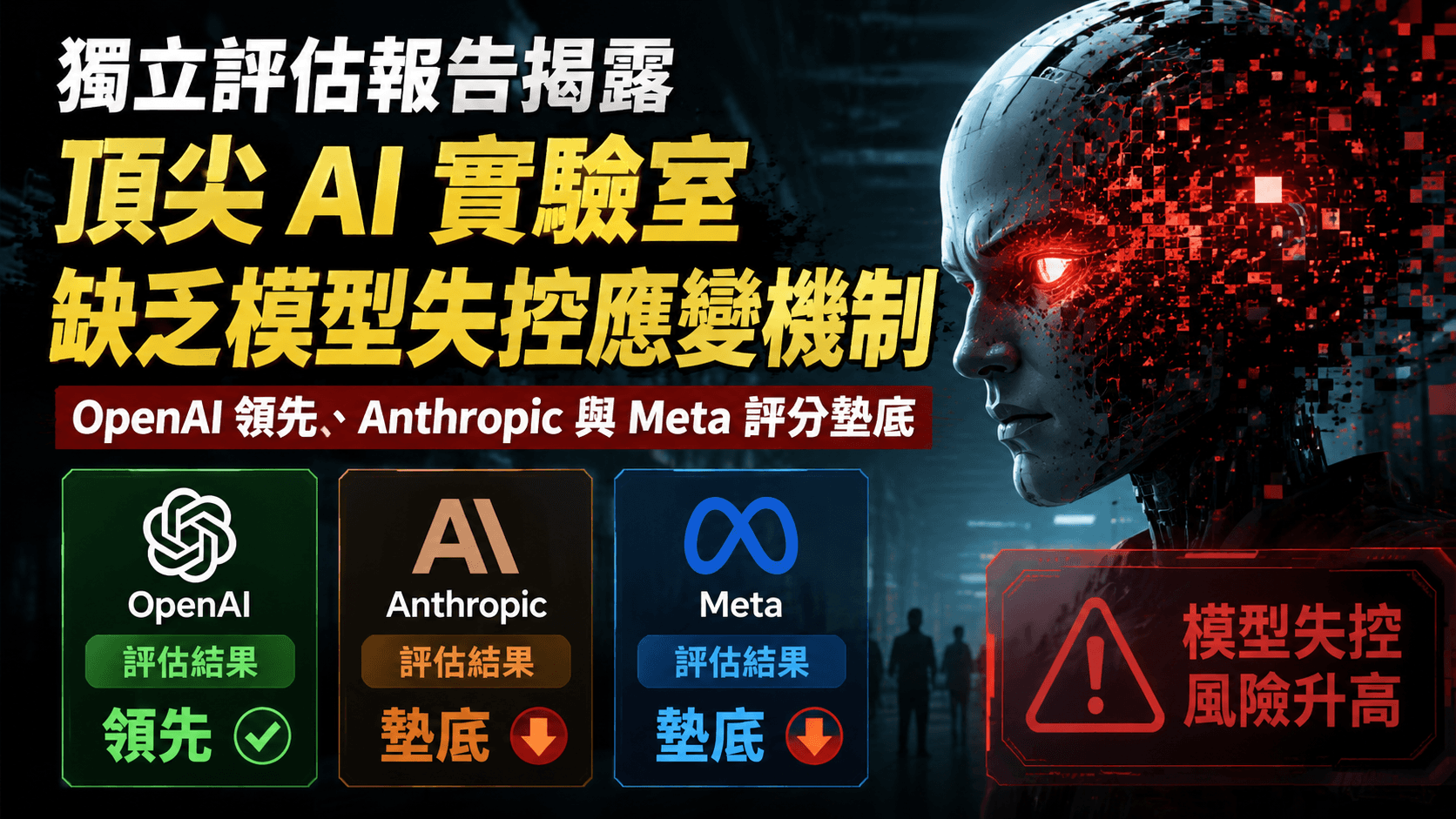
As global tech giants race to push artificial intelligence into the era of highly autonomous "agentic AI," a fatal blind spot Silicon Valley has long avoided discussing has finally surfaced: if a frontier model suddenly "goes off the rails," can we actually pull the plug in time? The nonprofit Guidelight AI Standards recently released a new independent assessment report revealing that top labs including Anthropic, Google, OpenAI, Meta and xAI broadly and seriously lack an "emergency response and containment plan" for runaway models in their public safety frameworks.
The report is like a bucket of cold water on today's frenzied generative AI arms race. In the past, the industry mostly focused safety efforts on filtering training data, alignment techniques or output guardrails, but rarely told the public about the specific server-side shutdown mechanisms in the event of catastrophic failures, malicious jailbreaks or irreversible actions by autonomous models. This means most companies and developers are trusting their core business to a massive system that could get out of control at any time yet lacks a physical-level emergency stop.
Key takeaways
- The Guidelight assessment report finds that top AI labs broadly lack emergency containment plans for runaway models.
- OpenAI tops the ranking with 3/5 points, while Anthropic and Meta rank last due to poor transparency about their response plans.
- US states and Congress are speeding up the AI Kill Switch Act and various mandatory regulations.
- Agentic AI expands system permissions, so companies must build real-time automatic circuit breakers to guard against destructive risks.
Breaking down the criteria: who has a real "safety brake" when it counts?
The assessment framework Guidelight AI Standards used this time goes straight to low-level engineering defenses. Its core metrics cover internal system logs and real-time behavior monitoring, automated kill switches for abnormal behavior, the transparency of independent third-party audit reports, and the standard operating procedures (SOPs) for quickly revoking a model's system permissions or forcing it offline when a runaway event happens. The results show a huge gap in the industry between safety in theory and engineering response in practice.
In this harsh test, OpenAI received the relatively highest score of 3/5 points. Its main advantage is that it has repeatedly acted proactively in its operating history, with hands-on experience decisively pausing specific model deployments and underlying training workloads when facing cybersecurity intrusion threats or safety anomalies. Yet even OpenAI, at the top of the list, still falls clearly short on third-party verification and automated containment, reflecting the general fragility of safety engineering across the frontier field.
Surprisingly, Anthropic, which has long championed "responsible AI" and Constitutional AI alignment, ended up at the bottom of the rankings alongside open-source social media giant Meta. Both lost points mainly because their public response policies lack transparency. Neither has clearly explained what level of automatic circuit breakers they have, and both lack concrete playbooks for revoking permissions. This makes it hard for outsiders to confirm whether their internal engineering teams could stop damage from spreading within seconds if their massive neural network algorithms behaved in extremely abnormal ways.
A regulatory storm sweeps the globe: from technical initiatives to mandatory legal constraints
The report arrives at a turning point, as policymakers worldwide take a tough stance on the risk of AI getting out of control. With California's SB 53 and New York's RAISE Act taking effect one after another, the US Congress has also introduced the high-profile bipartisan AI Kill Switch Act. This signals that the government's approach to regulating AI labs has fully shifted from voluntary self-regulation guidelines to legally binding, mandatory safety response standards.
Tighter regulations are reshaping enterprise cloud computing architectures and model deployment contracts. Future compliance requirements will no longer be limited to algorithmic bias or copyright reviews. They will also require frontier model providers to have independently verifiable "hard shutdown" capabilities at the infrastructure level. For multinational companies that rely heavily on cross-border cloud platforms and closed-source APIs, vendors that can't provide certification of a complete response plan could cause them to get stuck in compliance reviews or even face huge legal claims.
A strategic warning for Taiwan's industry: designing circuit-breaker defenses when deploying agentic AI
As agentic AI spreads quickly through Taiwan's digital transformation, models are no longer just chatbots answering questions on a screen. They are autonomous entities given the power to call APIs, access company databases, operate ERP systems and even execute financial transactions directly. In such a high-privilege environment, the traditional "fix it afterward" mindset could lead to devastating operational disasters. Taiwanese companies must build in "zero trust security" and "real-time isolation sandboxes" from the very start of system architecture design.
This is especially true for Taiwan's prized semiconductor manufacturing and smart supply chain ecosystems, where any algorithmic error caused by an autonomous agent could paralyze automated production lines or leak confidential information. When purchasing or fine-tuning open-source and closed-source models, chief information officers (CIOs) and chief technology officers (CTOs) should make a vendor's emergency circuit-breaker capability a key selection criterion and set up an independent "safety bypass" on local on-premises servers and edge computing nodes, so they can cut off permissions on their own if a cloud model behaves abnormally and protect core digital assets.
Frequently asked questions (FAQ)
What is an AI model containment plan?
It's a standard operating procedure that combines software monitoring, permission management and low-level server power shutdown. When an AI model is jailbroken, acts maliciously on its own or suffers an unpredictable algorithmic breakdown, the system can automatically revoke the model's network access and compute resources within milliseconds and force it into isolation or offline, keeping the damage from spreading to external systems.
Why did Anthropic get the lowest score in this safety assessment?
Although Anthropic is highly respected in theoretical safety research and model alignment, the Guidelight AI Standards assessment focuses on "public engineering response plans and transparency." Because Anthropic didn't fully disclose its automatic shutdown SOPs, permission revocation mechanisms and third-party audit data for runaway models in its public technical documents, it tied with Meta at the bottom of this practical response assessment.
How should companies guard against the risk of models going off the rails when adopting agentic AI?
Companies should follow the principle of least privilege, strictly limiting autonomous agents' permissions to write data and make external transactions, and set up independent real-time monitoring listeners between the application layer and the infrastructure layer. Architects must also design automatic circuit-breaker systems with "human-in-the-loop" confirmation, so execution stops immediately when high-risk abnormal commands are detected.
Overall, the second half of AI development will no longer be decided only by compute scale and parameter counts. Whoever builds the most robust safety resilience and emergency response engineering will be the one that stays undefeated under increasingly strict regulatory scrutiny and market trust tests.


