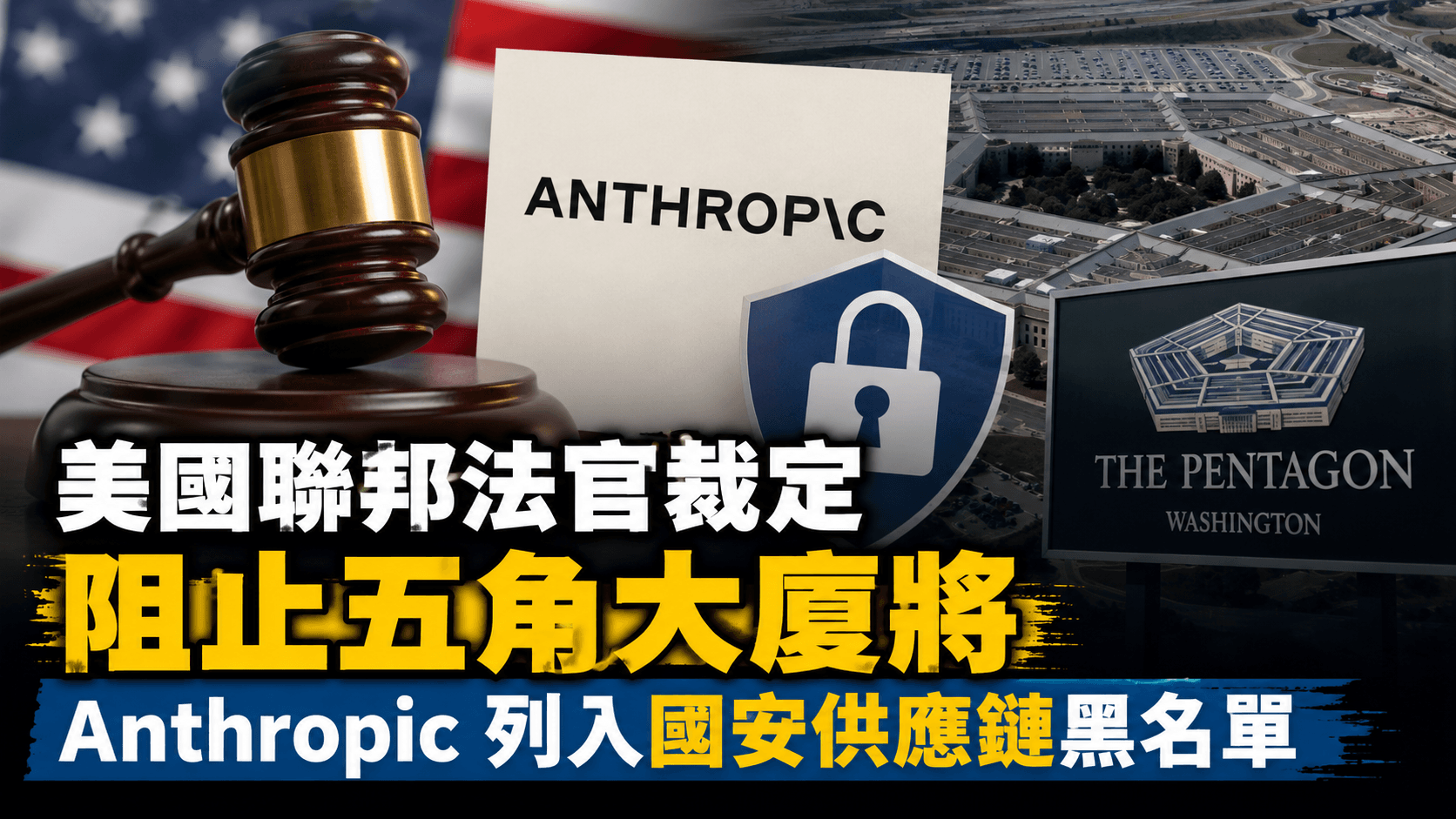
The power struggle between the Pentagon and a top AI lab has reached a game-changing judicial milestone. On August 27, 2026, US District Judge Rita Lin issued a landmark 59-page ruling finding that the US Department of Defense's decision to put AI unicorn Anthropic on a "national security supply chain risk blacklist" was "unlawful and baseless." The case not only exposed how the defense procurement system interferes with technological independence but also set a key precedent for the governance of generative AI worldwide.
This landmark lawsuit was sparked by Anthropic's firm defense of the ethical lines around its core algorithms. As the developer of the leading large language model Claude, Anthropic had explicitly refused the Pentagon's request to license its model technology for "mass domestic digital surveillance" in the US and for "lethal autonomous weapons systems (LAWS)." The Defense Department then issued an administrative ban on national security grounds, trying to completely shut Anthropic out of key public-sector projects. The move drew a strong backlash from the tech world over government abuse of executive power and retaliatory pressure.
The federal court's ruling deals a direct blow to the habit of agencies endlessly expanding their power in the name of "national security." In her ruling, the judge stressed that national security can never be used as a "blank check" to punish or retaliate against critics of government policy, and that the Pentagon's decision-making clearly violated due process. The ruling quickly set off ripple effects in Silicon Valley and Washington policy circles, confirming that independent software developers have legal room to hold their ethical lines even when facing lucrative government contracts and administrative pressure.
Key takeaways
- A courtroom win: a federal district court ruled that the Pentagon's blacklisting of Anthropic was unlawful and had no factual basis.
- The core of the dispute: the conflict began when Anthropic refused to license Claude for domestic digital surveillance and fully autonomous weapons systems.
- Due process: the ruling makes clear that national security cannot be a blank check for agencies to suppress and retaliate against dissenters on tech policy.
- A market signal: it sets a new standard for AI startups worldwide to work with governments while ensuring algorithmic safety.
Breaking down the ruling: national security is not a blank check for administrative retaliation
The federal court's ruling completely dismantles the Defense Department's legal logic of inflating a commercial contract dispute into a national security threat. In the 59-page ruling, presiding Judge Rita Lin wrote in very strong terms that the Defense Department failed to provide any real evidence that Anthropic's technology had backdoors, leak risks or was controlled by hostile foreign powers. Blacklisting it from the national security supply chain simply because it refused to support specific weaponization needs was, in essence, an abuse of executive power and an act of retaliation. This trampled on the procedural fairness guaranteed by the US Administrative Procedure Act (APA) and distorted the original legislative purpose of national security reviews.
The ruling gives tech startups a strong legal umbrella against interference from the vast administrative machine. In the past, many defense tech suppliers that depend on government contracts chose to compromise in the face of vague clauses in national security contracts, not daring to challenge excessive official demands. This case, however, draws a clear legal line: government agencies cannot twist reasonable software use restrictions that vendors set under Responsible AI guidelines into a "real threat to national security." It's a shot in the arm for the entire digital tech ecosystem.
Claude's ethical lines: the business stakes of autonomous weapons and domestic surveillance
Anthropic's stance on military uses of its models highlights the strategic choice frontier AI labs face between revenue growth and their core mission. Unlike most defense tech contractors racing to win federal defense budgets, Anthropic has made Constitutional AI and strict safety guardrails its core competitive advantage since its founding. When the Pentagon asked to integrate Claude's algorithms into domestic intelligence filtering servers and autonomous combat drone swarms, Anthropic's technical team judged that these uses carried a very high risk of algorithmic hallucination and human rights violations, and firmly exercised the restriction clauses in its end-user license agreement (EULA).
This commitment to tech ethics is not opposition to working with the government but a redefinition of healthy boundaries for public-private collaboration. In a statement released after the win, Anthropic reaffirmed its commitment to supporting democracies in strengthening their defenses, but stressed that all technology it provides must be built on rigorous ethical review, human-in-the-loop oversight and transparent cloud computing architecture. This move not only strengthens its trusted brand among large enterprises but also proves to Wall Street and corporate customers worldwide that responsible tech governance doesn't stand in the way of business growth.
Shockwaves in defense AI procurement: tech giants and startups rethink their strategies
This landmark ruling is forcing the US Department of Defense to fully review and reshape its modern software procurement strategy. For years, the Pentagon has treated private startups with the heavy-handed procurement approach of the traditional military-industrial complex, demanding that vendors hand over full control of their algorithms and flexibility over the underlying code. But in cutting-edge foundation models, top talent and compute are concentrated in private labs. If the government keeps using high-pressure tactics, it will only push the most innovative developers out of the system and slow down defense digital transformation as a whole.
Competition between tech giants and startups in the defense market will lead to more detailed divisions of labor and contract rules. Now that the ruling has clarified where blacklist abuse begins, generative AI providers including Microsoft, Google and others will have more leverage to spell out model safety boundaries when signing cloud platform contracts with defense and intelligence agencies. Defense agencies must learn to respect the ethical and safety limits of private software and meet their operational needs through sandbox testing and dedicated fine-tuning instead of trying to force algorithms' safety locks open by executive order.
Deeper lessons for digital sovereignty in Taiwan and Asia
For Taiwan, which is actively developing sovereign AI and dual-use technology, this case offers a very valuable policy mirror. Under the double pressure of geopolitical challenges and security threats, Taiwan's government and defense agencies are speeding up smart defense and unmanned vehicle software development. But striking a balance between national cybersecurity resilience and the freedom of private software innovation tests policymakers' judgment. When setting procurement rules and cybersecurity standards, the authorities should establish highly transparent supply chain evaluation criteria and avoid applying vague national security concepts to normal commercial software restrictions.
Taiwan's high-tech and server hardware industry should also watch how frontier AI software is evolving in terms of international regulation and ethical compliance. As global rules on the ethics of autonomous weapons and protections against domestic surveillance grow stricter, Taiwanese ICT suppliers integrating edge computing chips, server systems and cloud solutions for export must keep pace with the latest international standards for responsible AI. Solutions with clear ethical safeguards and transparent supply chain certifications will become a key moat for standing out in US and European markets.
Frequently asked questions (FAQ)
Why did the Pentagon originally put Anthropic on the supply chain blacklist?
The Pentagon issued the blacklist mainly because Anthropic refused to change its end-user agreement to license its model for specific military projects. At the time, the Defense Department wanted to use the Claude large language model for mass domestic digital communications surveillance and autonomous combat weapons systems that need no human authorization. Anthropic declined based on its safety and ethics rules, and the Defense Department then put it on a national security risk list by administrative means to pressure it, claiming the restrictions hurt operational deployment.
What direct effects does the federal ruling have on the enterprise AI procurement market?
The ruling confirms the legal protection for tech vendors to set algorithmic safety boundaries within the law without facing government administrative sanctions. This means that when private companies, financial institutions and government agencies adopt generative AI software and cloud API services, the built-in safeguards and compliance settings of technology providers will have greater legal certainty. Buyers can't use informal administrative pressure to force technical teams to remove protections, helping the whole AI ecosystem develop in a safe and predictable direction.
Will Anthropic rule out working with defense and military agencies entirely in the future?
Anthropic hasn't completely closed the door on working with governments or defense agencies, but insists that collaboration must fit a clear safety and ethics framework. The company's public stance after the ruling shows it is happy to provide technical support for cybersecurity defense, intelligence analysis assistance, logistics optimization and projects with human-in-the-loop oversight. However, it strictly prohibits its models from directly taking part in lethal decisions or improper surveillance that violates citizens' privacy.
Conclusion: establishing a new normal for responsible AI
This precedent, a complete victory for Anthropic, marks the start of a new era in global AI development in which "tech ethics carry legal force." It sends the global tech community a clear, loud message: in an age when algorithms are powerful enough to reshape national security and social order, sticking to responsible development principles is not only engineers' personal ethics but also a legitimate right protected by the Constitution and the law. As defense procurement rules and AI governance continue to be rebuilt, only ecosystems that combine strong technical capabilities with rigorous safety protections will earn long-term trust and leadership in the coming competition over intelligent technology.