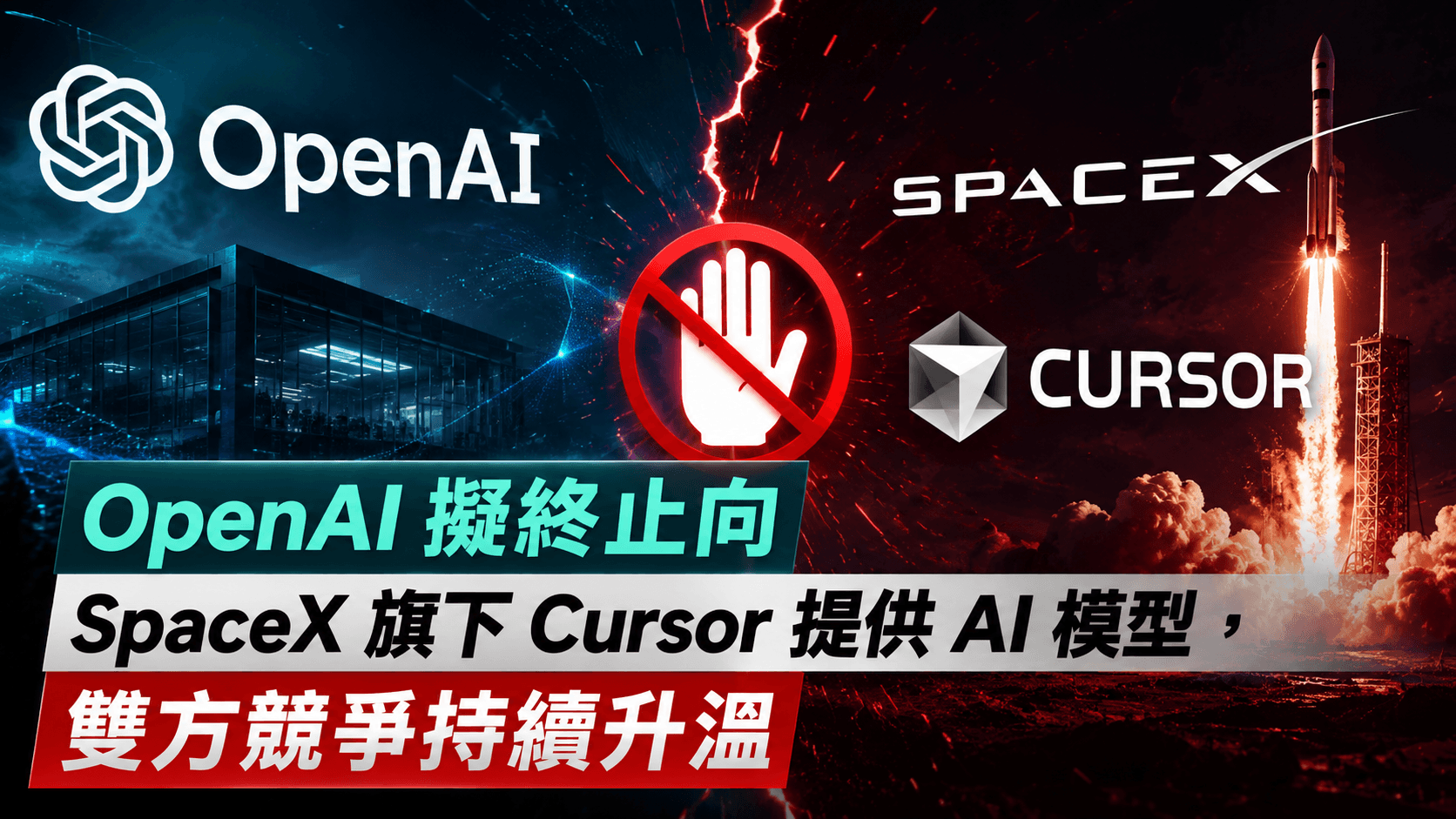
The global generative AI and developer tools ecosystem has been hit by a major shake-up. On August 28, 2026, OpenAI officially announced plans to stop providing model support to the popular AI code editor Cursor. The sudden decision reignited the years-long feud between two Silicon Valley titans, Sam Altman and Elon Musk, and pushed the front line of competition in generative AI from foundation models all the way to the integrated development environments (IDEs) that engineers use every day.
The storm stems from SpaceX's announcement in June 2026 that it would acquire Cursor's parent company Anysphere in a stunning US$60 billion all-stock deal, which closed in August. OpenAI then cited the "change of control " clause in its contract as the legal basis and formally notified Cursor that it will cut off all API model connections on November 12, 2026, saying the acquisition had completely shaken the foundation of trust and commercial commitments between the two sides.
Facing OpenAI's strategic blockade, Musk stayed true to his maverick style, casually responding on X that he "couldn't care less." Meanwhile, rival Anthropic sensed a great opportunity to expand, quickly announcing that it will allocate large amounts of cloud computing resources to fully deepen support for its Claude models on the Cursor platform. A battle for control over the developer ecosystem, cloud infrastructure and the model supply chain has officially begun.
Key takeaways
- OpenAI ends support: under the change of control clause, it plans to stop supplying GPT models to Cursor on November 12, 2026.
- SpaceX's huge acquisition: in August, SpaceX completed its US$60 billion all-stock acquisition of Cursor's parent company Anysphere, fueling the rivalry.
- Anthropic steps in fast: Anthropic immediately announced more compute resources and stronger, comprehensive technical support for Claude models in Cursor.
Legal contracts and business defenses: the power struggle behind the change of control
OpenAI's use of the change of control clause is, in effect, a carefully considered business defense strategy. In enterprise software and API licensing, "change of control" clauses usually protect technology suppliers from having their core technology indirectly delivered to a major competitor. Once SpaceX acquired Anysphere, Cursor was no longer a neutral startup tool but a direct part of Musk's vast tech empire. This means the model outputs, user interaction patterns and algorithmic feedback that OpenAI provides could at any time indirectly feed into the training of Musk's xAI and Grok models, prompting OpenAI to build a moat within the legal deadline.
The dispute highlights how fragile and exclusive the supply chain for large language models as a service (MaaS) is. For developer tools that rely heavily on third-party APIs, the supply of core algorithms can be cut off without warning at any time because of acquisitions or competitive dynamics. OpenAI's grace period only runs until November 12, 2026, which means the Cursor team must completely rebuild its multi-model routing architecture and the foundations of its prompt engineering in less than three months, or its millions of paying software engineers will face a cutoff of GPT models.
A reshaped market: Anthropic's windfall and the rise of multi-model architectures
By quickly committing cloud compute resources, Anthropic is becoming the biggest winner of this platform blockade. As OpenAI's strongest rival, Anthropic's Claude 3.5 and next-generation reasoning models already had an excellent reputation for code generation, refactoring and long-context understanding. By immediately announcing more investment in server compute clusters to absorb the GPT traffic that will shift over, Anthropic can instantly grow its market share among professional engineers and build an unbreakable developer moat through Cursor.
Musk's confident stance suggests Cursor will eventually move toward its own models and deep vertical integration with xAI. Although Musk said publicly that he isn't afraid of the cutoff, the industry widely believes SpaceX's real ambition in spending US$60 billion is to make Cursor the ultimate front end for xAI applications. By natively integrating Grok's code-specialized models into the Cursor editor, SpaceX can quickly build a vertically integrated AI development environment, from aerospace software engineering to consumer developer tools, and completely free itself from external API providers.
Far-reaching lessons for Taiwan's software industry and developer ecosystem
Taiwan's tech industry and digital development teams must face up to the major operational risk of depending on a single AI model supply chain. When adopting AI-assisted coding, most Taiwanese software service companies, fintech institutions and IT departments at high-tech manufacturers rely heavily on frontier tools like Cursor combined with OpenAI's APIs. This cutoff is a wake-up call for Taiwan's technology leaders (CTOs): when planning generative AI development workflows, companies must speed up adoption of a "multi-model fallback architecture" and on-premise open-source model deployments to avoid having R&D disrupted by business battles between international giants.
Local cloud computing and dedicated software development toolchains are reaching a new strategic turning point. As generative AI shifts from generalist models to vertical tools, Taiwanese companies should go beyond their strengths in server hardware manufacturing and the semiconductor supply chain and actively develop advanced model fine-tuning talent and their own development environments. Controlling model routing and local server compute will be the core competitive advantage that keeps Taiwan's software ecosystem agile and secure amid global geopolitics and waves of tech blockades.
Frequently asked questions (FAQ)
Can Cursor users still use GPT models after November 12, 2026?
After that deadline, the OpenAI models built into Cursor will stop working entirely. Unless there is a major turn in contract litigation or business negotiations, Cursor users won't be able to use GPT models through the official default channel. The system is expected to switch by default to Anthropic's Claude models or xAI's specialized models, and users may need to set up their own OpenAI API key for specific needs.
What is the main strategic goal of SpaceX's acquisition of Cursor's parent company Anysphere?
SpaceX's acquisition aims to build world-class AI-native development infrastructure for its aerospace software engineering and xAI. By buying Anysphere for US$60 billion, Musk not only gets the world's most mature AI code editor and data feedback from millions of top engineers but can also speed up real-world use of his own Grok models, forming a complete closed-loop ecosystem from compute and algorithms to developer tools.
How should enterprise development teams respond to this AI dev tool cutoff crisis?
Companies should immediately set development standards that support dynamic switching between multiple models and evaluate open-source alternatives. We recommend that technical leaders review how much their teams depend on current coding assistants, adopt a multi-track architecture that supports Claude, the Llama series and self-hosted local models, and put clear data privacy and supply chain risk management in place so core software development isn't disrupted by changes to external APIs.
The split between OpenAI and SpaceX-owned Cursor marks the definitive end of the "neutral honeymoon" in generative AI and the start of an era of vertical integration dominated by rival giants. Future software development won't just be a competition over editor features but a combined battle over cloud compute, foundation models and proprietary data flows behind the scenes. With stepping in forcefully and pressing forward, the AI-assisted development market will see a more diverse competitive landscape, and developers who stay flexible and independent in their architecture across a multi-model ecosystem will be the biggest winners of this technological upheaval.