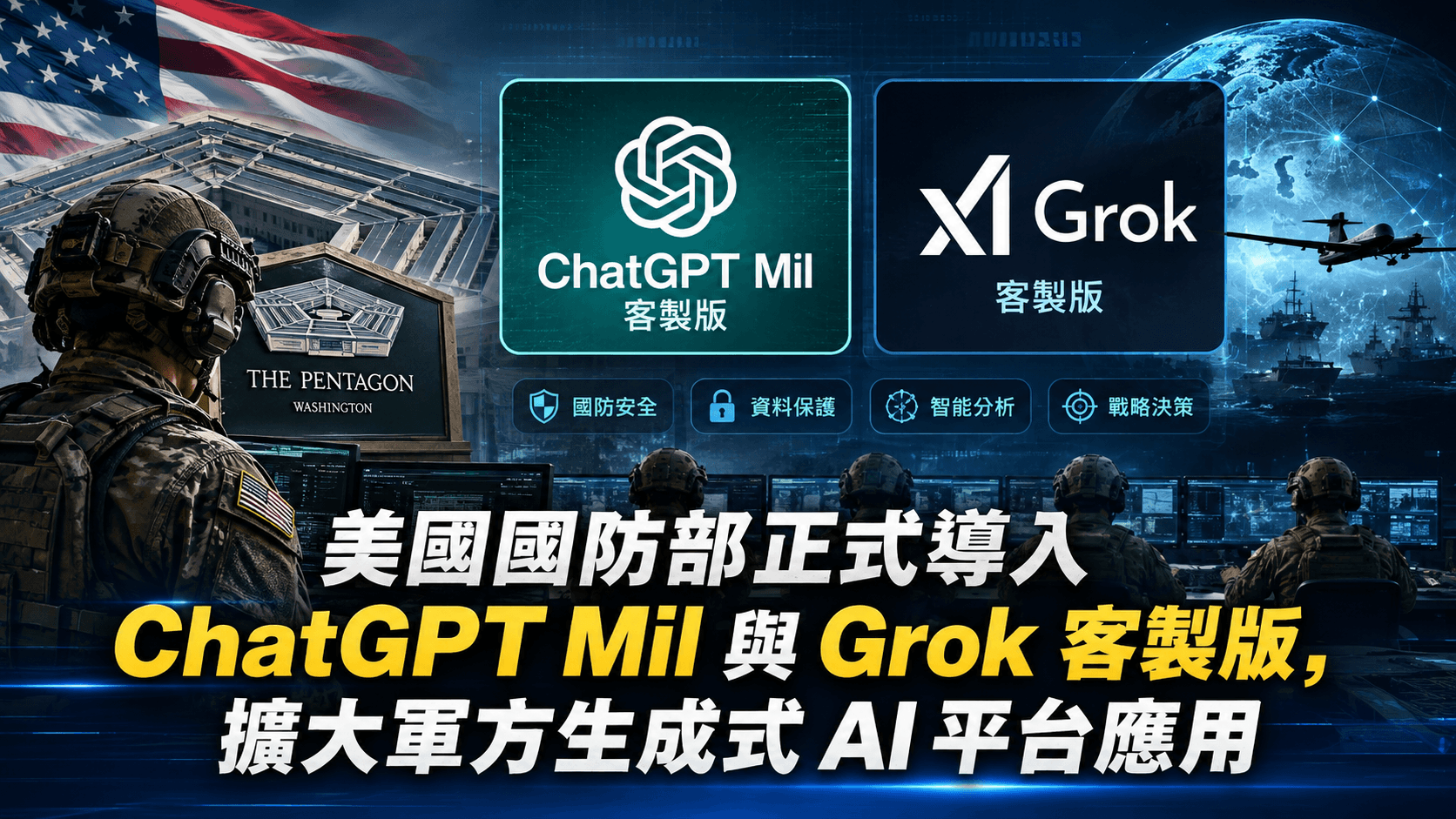
The US Department of Defense (Pentagon) officially announced on August 31, 2026 that it has launched ChatGPT Mil and Grok for Government, customized for military needs, on its dedicated secure portal "GenAI.mil ," signaling that the world's most powerful military is fully bringing cutting-edge generative AI into the core of defense operations and logistics. This major deployment is open to all 3 million US military and civilian personnel. It not only breaks the stereotype of defense agencies being slow to buy advanced commercial technology but also shows that modern military competition has moved from a hardware arms race to a contest of smart algorithms and battlefield decision speed.
The rapid spread of military digital infrastructure is already backed by data: the platform has quickly attracted more than 1.7 million unique users, showing huge demand among rank-and-file personnel for generative AI tools. After integrating Google Gemini, OpenAI's dedicated models and xAI's systems one after another, the Pentagon is using a multi-model architecture to build a modern military software ecosystem that is highly fault-tolerant and secure, completely rewriting traditional command and administrative work.
The core challenge of this defense tech transformation is balancing computing performance with national security. The dedicated military platforms fully exclude the data collection mechanisms common in consumer products, ensuring there is no risk of classified military information leaking. Through strict isolation and access control, the US military is showing the world how to turn the strongest compute from private tech giants into real defensive capability without sacrificing the protection of secrets.
Key takeaways
- A massive deployment: the Pentagon's "GenAI.mil" is open to 3 million personnel and passed 1.7 million unique users soon after launch.
- Two flagship models go live: the dedicated ChatGPT Mil and Grok for Government, which works with Starshield technology, are now available, following the earlier integration of Google Gemini.
- Zero data sent back: the military platform completely cuts off external data collection, so defense secrets can't be used to train the models.
- Clear division of roles: ChatGPT focuses on administration, logistics and policy planning, while Grok focuses on satellite link integration and frontline tactical decisions.
Technical architecture and security barriers: how do military models prevent data leaks?
The first requirement for deploying military-grade generative AI is absolute physical and logical isolation. Using a dedicated cloud environment and secure server clusters, the Pentagon completely blocks the data feedback loop that commercial models commonly use for training. Unlike typical consumer apps that use chat logs to improve their algorithms, the GenAI.mil platform uses top-security encrypted channels and permission controls, ensuring that when personnel handle sensitive information and defense strategy documents, data only moves within certified security boundaries. This eliminates at the root the risk of secrets leaking to third-party vendors.
Deploying deep learning algorithms in the military requires both stability and real-time response. The multi-layer filtering architecture used by the US military can detect and block malicious prompt attacks and hallucinated output in real time. By deploying dedicated safeguards and real-time audit logs on the server side, the system can precisely track how every command was generated and the permissions of the operator, making highly automated decision support both traceable and compliant and giving military software systems an unbreakable defense in depth.
From administrative automation to the tactical edge: the roles and real-world value of the two flagship models
ChatGPT Mil's core mission is to free personnel from heavy administrative workloads, greatly improving the digital efficiency of cross-department document drafting, logistics scheduling and military policy planning. The daily operation of a modern military is full of complex regulation manuals and unclassified document reviews. With OpenAI's advanced natural language processing, staff can extract key information from technical manuals hundreds of pages long in seconds, shortening communication cycles between units and making military administration more agile than ever.
Grok for Government has a very different tactical role. Deeply integrated with SpaceX Starshield low-earth-orbit satellite network communications, it focuses on improving decision-making and dynamic supply chain management in the field. On a fast-changing front line, commanders can call up AI inference results combined with satellite telemetry right from a tactical tablet or terminal screen, assess supply route risks within seconds and produce the best deployment plan, turning an information advantage into decisive battlefield initiative.
Reshaping the defense tech business model and strategic lessons for global supply chains
The Pentagon's strategy of breaking single-vendor monopolies and adopting products from multiple giants such as OpenAI, xAI and Google marks a shift in defense procurement toward an open, flexible, multi-model competitive architecture. This "don't put all your eggs in one basket" procurement philosophy not only motivates private tech companies to keep improving their dedicated algorithms and security architectures but also helps the military avoid the major strategic risk of a single point of failure at a critical moment because of technology lock-in.
This shift offers valuable strategic lessons for Taiwan's tech industry and its digital defense resilience, especially in integrating high-end edge computing hardware with sovereign AI systems. As military AI gradually moves from large cloud centers to frontline edge devices, demand will surge for highly secure dedicated servers, rugged terminal screens and low-latency communication modules. If Taiwan's supply chain seizes this hardware-software integration opportunity, it will hold an indispensable strategic position in the global defense tech ecosystem.
Frequently asked questions (FAQ)
How does GenAI.mil ensure classified military information isn't absorbed into AI model training?
The military platform's architecture completely cuts off any channel for sending data back to public commercial servers. All conversations and input commands are protected by strict military encryption protocols and are strictly prohibited from being used to train external commercial algorithms, giving the Pentagon's sensitive policy and tactical information the highest level of privacy protection.
How do ChatGPT Mil and Grok for Government divide up military tasks?
The two play complementary roles. ChatGPT Mil focuses on unclassified administrative documents, cross-department policy planning and everyday logistics software work, while Grok for Government is deeply integrated with the SpaceX Starshield satellite communications network and supports frontline personnel with dynamic tactical decisions, real-time intelligence integration and battlefield supply chain optimization.
What can Taiwan's defense and tech industries learn from the US military's adoption of modified commercial AI?
Through "GenAI.mil," the US military has proven that sovereign security control can be combined with advanced commercial compute. As Taiwan pushes digital transformation and national security, it can borrow this multi-model architecture and combine it with Taiwan's leading semiconductor manufacturing and secure server R&D strengths to build a secure, smart defense system that is both independent and high-performing.
In short, the US military's launch of ChatGPT Mil and is not only a milestone for generative AI in defense but also signals that global military competition is entering a new era of fully , decision-making. In the future, the gap between nations' defense capabilities will no longer be decided only by the number of traditional weapons, but by who can turn compute, cutting-edge and secure networks into frontline advantage faster.